



What's Happening?
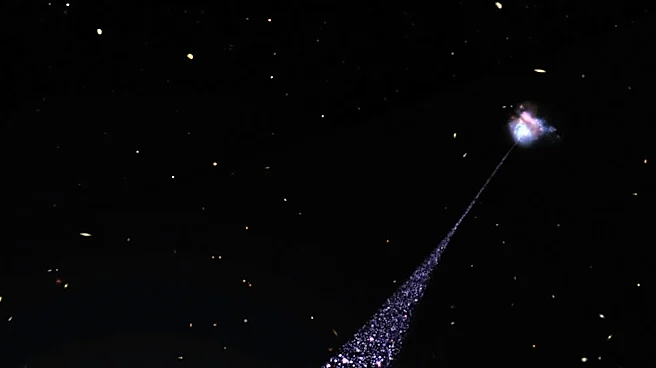
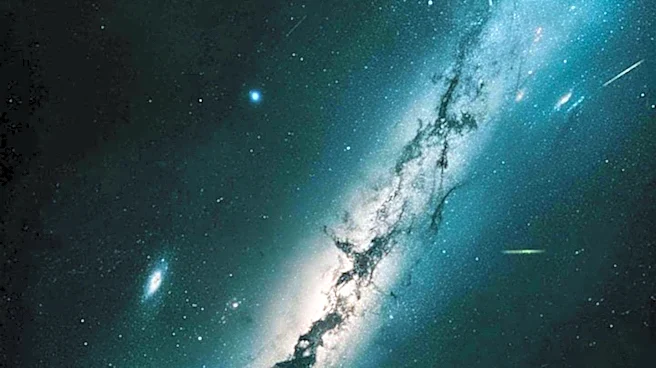
Recent cosmological hydrodynamical simulations have confirmed that the Milky Way's satellite galaxies are actively losing stellar mass, leading to the formation of extended stellar streams. This phenomenon, while surprising given the scarcity of observed
tidal tails around Milky Way satellites, suggests that much of this debris may be hidden beneath the surface brightness limits of current wide-area photometric surveys. The simulations, which include studies like Riley et al. (2025) and Shipp et al. (2025), utilize 'accreted particle lists' from public data releases, such as the Auriga project (Grand et al., 2024). These lists assign star particles to the subhalo they were bound to at birth, allowing researchers to track the evolution and disruption of these systems over cosmic time. The findings indicate that the disruption of satellite galaxies is a more prevalent process than previously observable.
Why It's Important?
This research is important for several reasons in the field of astrophysics and our understanding of galaxy formation. It provides crucial insights into the dynamics of the Milky Way's halo and the evolution of its satellite galaxies. The confirmation of widespread stellar stream formation, even if currently unobservable, helps reconcile discrepancies between theoretical models and observational data regarding the 'missing satellites problem.' Understanding how satellite galaxies lose mass and form streams is vital for refining models of dark matter distribution and the gravitational interactions within galactic systems. This knowledge can also inform future observational strategies, guiding astronomers on where and how to look for these elusive stellar streams, potentially leading to new discoveries about the Milky Way's accretion history and the properties of its dark matter halo.
What's Next?
Future research will likely focus on developing more sensitive observational techniques and instruments capable of detecting the faint stellar streams predicted by these simulations. Astronomers may also refine existing photometric surveys or design new ones specifically tailored to identify these low surface brightness features. Further advancements in cosmological simulations will aim to improve their resolution and incorporate more complex physical processes to better model the disruption of satellite galaxies. Collaboration between theoretical and observational astrophysicists will be crucial to validate these simulation results and enhance our understanding of galactic evolution. The ongoing development of new telescopes and data analysis methods will play a key role in bridging the gap between simulated predictions and observable phenomena.
Beyond the Headlines
The implications of this research extend beyond the immediate study of galactic dynamics. The disruption of satellite galaxies and the formation of stellar streams are direct consequences of the gravitational interactions within the Milky Way's dark matter halo. By studying these processes, scientists can gain a deeper understanding of the nature of dark matter itself, which constitutes a significant portion of the universe's mass but remains largely mysterious. The findings also highlight the limitations of current observational technology and the vastness of what remains hidden in the cosmos. This ongoing quest to uncover the universe's secrets pushes the boundaries of scientific inquiry and technological innovation, inspiring new generations of scientists and engineers to explore the fundamental questions about our place in the universe and the forces that shape it.