




What's Happening?
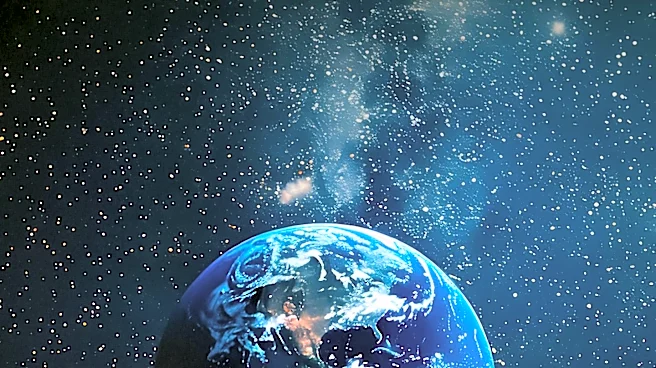
The Rare Earth Hypothesis posits that while the observable universe may contain up to a septillion stars, the emergence of complex life could be extraordinarily rare. This hypothesis challenges the assumption that the vast number of stars guarantees the existence
of complex extraterrestrial life. It suggests that several rare biological and environmental conditions must align for complex life to develop, such as a suitable star, a rocky planet with liquid water, and a stable climate. The hypothesis highlights the potential coexistence of cosmic abundance and biological loneliness.
Why It's Important?
The Rare Earth Hypothesis has profound implications for our understanding of life's uniqueness and the conditions necessary for its development. If complex life is indeed rare, it underscores the importance of preserving Earth's biosphere and the delicate balance that sustains life here. It also influences the search for extraterrestrial life by guiding scientists to focus on specific conditions that may support life. This hypothesis challenges researchers to refine their models and assumptions about life's potential distribution across the universe.