



What's Happening?
Researchers have successfully simulated nearly every chemical reaction in a living bacterial cell, marking a significant advancement in computational biology. The study, led by Zane Thornburg, a computational biophysicist at the University of Illinois,
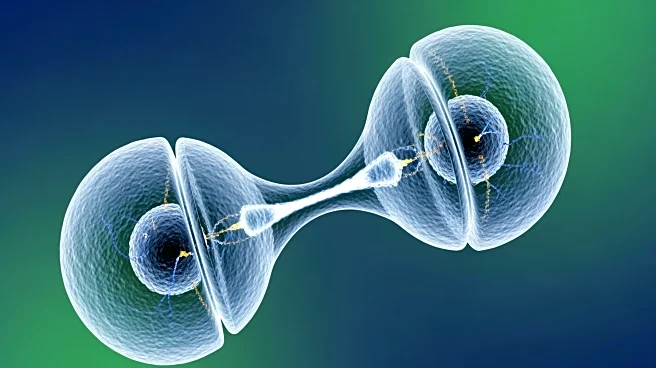
focused on a bacterial cell with a minimal genome, known as JCVI-Syn3a. This organism was engineered by reducing the genome of Mycoplasma mycoides to just 493 essential genes. The simulation aimed to model the cell's DNA, proteins, ribosomes, and other molecules as they change over time, adhering to real-world measurements. Despite some challenges, such as unknown functions of certain genes and computational limitations, the simulation successfully replicated the cell cycle, including DNA replication and cell division. The virtual cell took 105 minutes to divide, closely mirroring the time taken by real cells, although the simulation required six days on a supercomputer to complete.
Why It's Important?
This breakthrough in simulating bacterial cell division is crucial for advancing our understanding of fundamental life processes. By capturing the complex interactions of cellular components, the research provides insights into how life functions at a molecular level. This could have significant implications for biotechnology and medicine, potentially leading to new ways to manipulate cellular processes for therapeutic purposes. The ability to simulate cell division accurately also opens up possibilities for studying diseases at a cellular level, offering a platform for testing drug interactions and understanding genetic disorders. The achievement underscores the potential of computational models to complement experimental biology, providing a powerful tool for scientific discovery.
What's Next?
Future research will likely focus on refining the simulation to include more detailed interactions and to account for the unknown functions of certain genes. As computational power increases, these models could become more sophisticated, allowing for simulations of more complex organisms. Researchers may also explore applications in synthetic biology, using the model to design and test new cellular functions. Collaboration with experimental biologists will be essential to validate and expand the findings, ensuring that the simulations accurately reflect biological reality. The continued development of such models could revolutionize our approach to understanding and manipulating life at the cellular level.