







What's Happening?
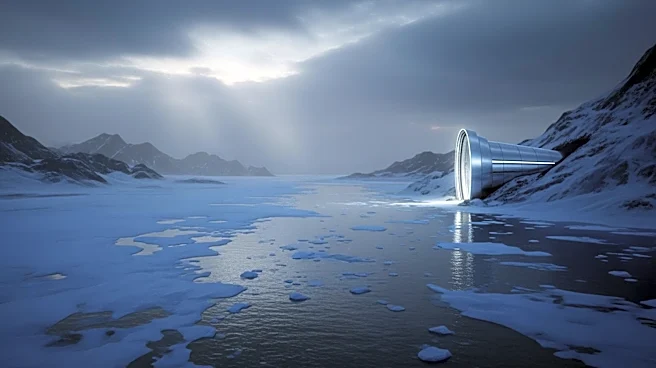
A proposal from the Kremlin envisions the construction of a tunnel under the Bering Sea, connecting Russia and the United States. This ambitious project, championed by Russian special envoy Kirill Dmitriev, aims to create a rail link from the Chukotka
Peninsula in Russia to the Seward Peninsula in Alaska. The proposed tunnel would be twice the length of the Channel Tunnel between Great Britain and France, and would involve building a rail system through Alaska, Canada, and into the United States. Despite the potential economic benefits, such as increased access to North American markets and reduced trade route lengths, the project faces significant geopolitical and environmental challenges. The ongoing conflict in Ukraine complicates the situation, as any collaboration with Russia could be seen as a normalization of relations, potentially undermining Western sanctions against Russia.
Why It's Important?
The proposal for a Bering Strait tunnel holds significant implications for international relations and global trade. If realized, it could enhance economic ties between Russia and the United States by facilitating faster and cheaper freight transport. However, the geopolitical context cannot be ignored. Engaging in such a project with Russia, especially amidst its ongoing conflict with Ukraine, could be perceived as a tacit endorsement of Russian actions, potentially straining U.S. relations with its Western allies. These allies are currently supporting Ukraine through sanctions against Russia. The project also poses environmental challenges, given the harsh Arctic conditions and seismic activity in the region, which could complicate construction and maintenance efforts.
What's Next?
While the proposal is still in its early stages, with no formal agreement between the U.S. and Russian governments, the idea continues to be explored. Russian officials have announced ongoing design work, but significant hurdles remain. The U.S. government has not endorsed the project, and it remains to be seen whether political and environmental challenges can be overcome. The international community will likely watch closely for any developments, as the project could have far-reaching implications for global trade and diplomatic relations.