



What's Happening?
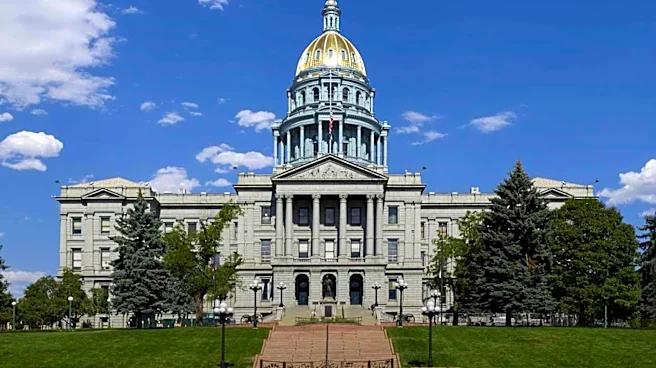
Colorado has formally submitted its proposal to host the proposed United States Space Academy, pitching Banning Lewis Ranch in eastern Colorado Springs as the site for the projected $8.2 billion permanent campus. President Trump signed an executive order
in August to initiate the creation of this institution, envisioned as a NASA-led federal academy focused on technical education, leadership development, and public service. NASA subsequently issued a Request for Information from interested states. Lieutenant Governor Dianne Primavera, who chaired the bid's advisory committee, noted the rapid work involved in preparing the proposal. Colorado's 100-page bid highlights the state's strong position in the space industry, citing its concentration of aerospace businesses, critical Space Force bases, and educational programs at institutions like CU Boulder and the U.S. Air Force Academy.
Why It's Important?
Securing the U.S. Space Academy would significantly bolster Colorado's role as a national leader in aerospace and defense. The estimated $8.2 billion investment and the creation of a major educational institution would bring substantial economic benefits, including job creation, increased research and development, and a further strengthening of the state's talent pipeline in STEM fields. The academy's presence would attract top talent and foster innovation, reinforcing Colorado's strategic importance to national security and space exploration. Governor Jared Polis emphasized the state's capability to meet the mission's requirements, stating that if the decision were to be based on merit rather than political considerations, Colorado is best suited. The competition for the academy is stiff, with other bids from major space hubs like Houston, Texas; the Space Coast of Florida; and Huntsville, Alabama.
What's Next?
If selected, Colorado anticipates breaking ground on the academy as early as next year. The proposed 508-acre site at Banning Lewis Ranch includes a 321-acre academy campus and an adjoining 187-acre Innovation District for research and industry partners. Under the proposal, Norwood Development Group would retain ownership of the Innovation District while selling or leasing the academy grounds to NASA. The first class of approximately 300 students is projected to begin studies at nearby UCCS in the fall of 2028, supported by faculty from various state universities. A permanent campus is expected to be completed by 2031, initially serving 1,200 students and eventually expanding to 4,000. A presidential commission will provide final recommendations to President Trump for approval, though the timeline for this decision remains unclear.
Beyond the Headlines
The bid for the U.S. Space Academy carries significant implications beyond economic development. It represents a strategic investment in the future of American leadership in space, emphasizing the critical need for a highly skilled workforce in this rapidly evolving sector. The establishment of such an academy would not only advance scientific and technological capabilities but also cultivate a new generation of leaders dedicated to public service in space. The competition among states highlights the broader national interest in securing these high-tech, high-impact institutions. The previous decision to move U.S. Space Command to Huntsville from Colorado Springs, which Colorado leaders described as a 'blatantly political decision,' adds a layer of political sensitivity to this current bidding process, underscoring the importance of a merit-based selection for the academy.