
What's Happening?
Jamelle Bouie, a New York Times columnist, has asserted that President Trump is engaged in an 'open revolt against the Constitution' through his administration's efforts to influence midterm elections.
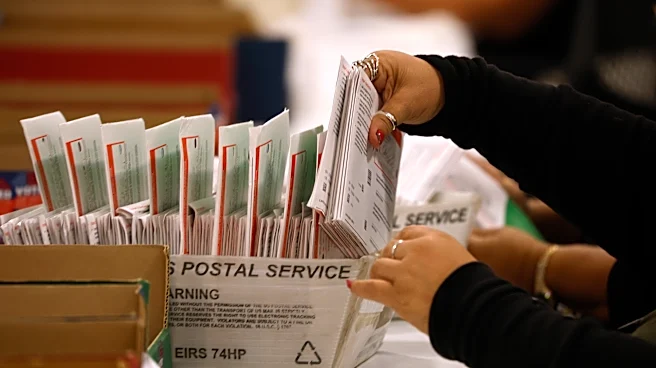
Bouie details a strategy involving a rule requiring states to provide lists of mail-in voters to the Postal Service to receive ballots. This rule, he argues, is an unconstitutional overreach into states' election prerogatives. The plan, as described by Bouie, anticipates federal courts blocking the rule, followed by the administration challenging these injunctions. The administration would then invoke the Supreme Court’s 'Purcell principle,' claiming it's too late to alter voting procedures and that the new rules should be considered the status quo. The ultimate goal, according to Bouie, is to create chaos and disruption in states relying on mail-in voting, potentially leading to voter suppression or casting doubt on election results. He notes that while the Supreme Court recently paused a lower court injunction on the proposed ballot rule due to it not being formally issued by the U.S.P.S., a Federal District Court has since issued a temporary restraining order, which the administration has appealed.
Why It's Important?
This situation carries significant implications for the integrity of U.S. elections and the balance of power between federal and state governments. If the administration's strategy were to succeed, it could fundamentally alter how elections are conducted, potentially disenfranchising voters and undermining public confidence in democratic processes. The 'Purcell principle,' typically used to prevent last-minute changes to election rules, is being weaponized, according to Bouie, to establish new, potentially unconstitutional, procedures. This could set a dangerous precedent, allowing future administrations to manipulate election logistics under the guise of maintaining stability. The Supreme Court's eventual decision on this matter will be crucial, as it will determine whether the Constitution's clear delegation of election administration to the states is upheld or if the executive branch gains unprecedented influence over voting procedures. The outcome could either reinforce democratic norms or pave the way for increased federal intervention in state-run elections, with lasting effects on American political stability.
What's Next?
The immediate next step involves the Supreme Court hearing the administration's appeal regarding the temporary restraining order issued by the Federal District Court. The Court will need to decide whether to uphold the lower court's injunction or allow the administration's proposed mail-in voting rule to proceed. This decision will likely come in a matter of weeks or days, given the proximity to the midterm elections. Depending on the Supreme Court's ruling, states that rely heavily on mail-in voting could face significant challenges in accommodating new rules or defending their existing procedures. Political leaders, civil society groups, and election integrity advocates will closely monitor these developments, with potential legal challenges and public protests likely if the administration's efforts are perceived as undermining voting rights. The broader political landscape will also be affected, as the debate over election integrity continues to be a central theme in national discourse, potentially influencing voter turnout and public trust in the electoral system.
Beyond the Headlines
Beyond the immediate legal and political ramifications, this situation highlights a deeper struggle over the foundational principles of American democracy. Bouie suggests that President Trump's actions are part of a 'larger effort...to end the American republic and supplant it with an authoritarian regime.' This raises profound questions about the resilience of democratic institutions and the checks and balances designed to protect them. The weaponization of legal principles, such as the 'Purcell principle,' to achieve political ends could erode the rule of law and public trust in the judiciary. Furthermore, the focus on mail-in voting as a point of contention underscores the ongoing partisan divide regarding election security versus voter access. This conflict has cultural and ethical dimensions, as it touches upon fundamental rights and the very definition of a free and fair election. The long-term implications could include a re-evaluation of election administration laws, increased polarization, and a sustained debate about the future of democratic governance in the United States.