


What's Happening?
An international team led by scientists from the Institute of Deep-sea Science and Engineering of the Chinese Academy of Sciences has discovered a vast underwater whale graveyard in the Diamantina region of the southeastern Indian Ocean. The discovery,
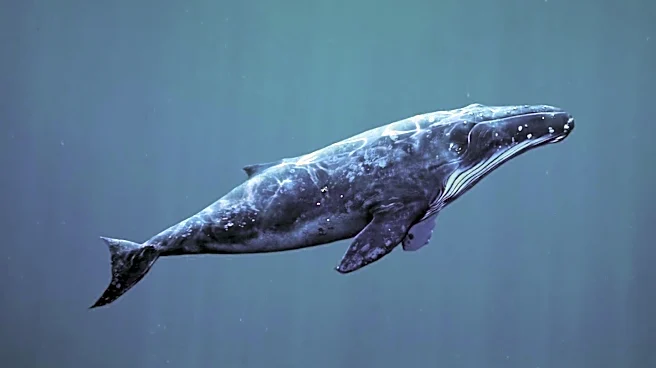
made at a depth of nearly 6,800 meters, includes 476 cetacean fossils and five active whale-fall ecosystems spread across approximately 1,200 kilometers of the seabed. Scientists estimate that over 10 million whale remains have accumulated in this region over at least 5.3 million years. The researchers identified the deepest active whale fall ever recorded, at a depth of 6,789 meters, extending the known depth limit for such ecosystems by more than 2,500 meters. The team also discovered fossils of beaked whales, including a newly identified extinct species named Pterocetus diamantinae.
Why It's Important?
The discovery provides significant insights into the evolution of cetaceans and the role of whale-fall ecosystems in deep-sea biodiversity and the carbon cycle. Whale falls, which occur when a cetacean carcass sinks to the ocean floor, support highly specialized ecosystems. This finding could transform the understanding of these ecosystems' distribution and their ecological roles. The research suggests that similar marine graveyards may exist in other parts of the world's oceans, offering further opportunities to study the evolutionary history of marine mammals and the dynamics of hadal ecosystems.