





What's Happening?
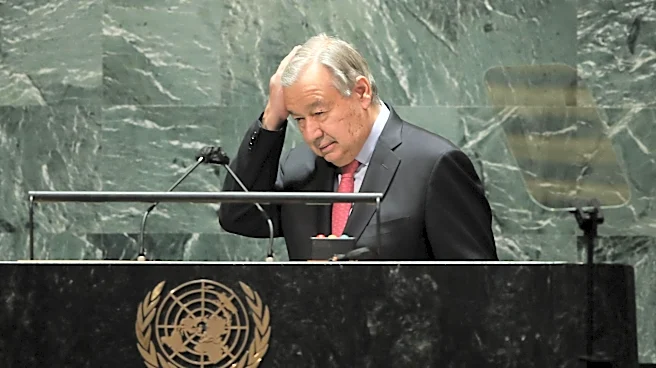
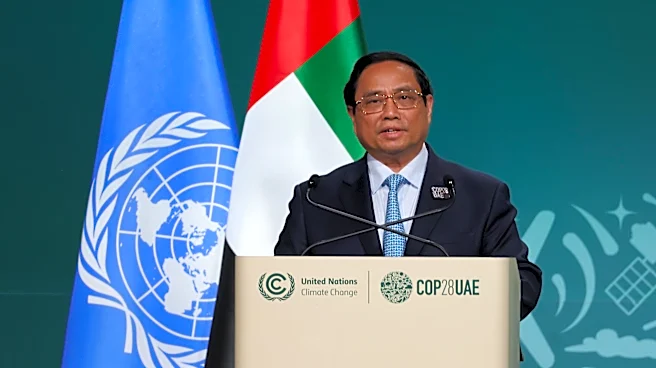
United Nations Secretary-General António Guterres has issued a stark warning regarding the climate crisis, emphasizing that the goal of limiting global warming to 1.5 degrees Celsius since pre-industrial times is no longer achievable. Speaking ahead
of UN climate talks in Turkey, Guterres described the situation as a "moment of truth," urging world leaders to take immediate and decisive action. He revealed that scientists informed him last year that the 1.5-degree target was no longer viable due to the excessive release of carbon dioxide and other greenhouse gases from burning fossil fuels. Guterres, who is in his final term as UN chief, expressed profound disappointment, stating that while the world has not failed, political leadership has. He stressed that protecting the planet requires a long-term strategic view, which is often absent in political systems where policies change frequently, hindering necessary sustained investment.
Why It's Important?
Secretary-General Guterres's declaration that the 1.5-degree Celsius warming limit is unattainable marks a significant and somber turning point in the global effort to combat climate change. This admission underscores the severity of the crisis and the inadequacy of current international responses. For the U.S., this means facing more intense and frequent extreme weather events, including heat waves, storms, floods, and droughts, which will have profound impacts on infrastructure, agriculture, public health, and the economy. The failure to meet this critical target will necessitate a rapid acceleration of adaptation strategies and a re-evaluation of national climate policies. It also highlights the immense pressure on U.S. political leaders to overcome short-term political cycles and implement long-term, consistent climate investments, as Guterres noted the lack of strategic vision in many political systems.
What's Next?
As UN climate talks commence, the urgent message from Secretary-General Guterres will likely intensify pressure on participating nations, including the U.S., to commit to more ambitious emissions reduction targets and robust climate financing. The focus will shift from merely limiting warming to 1.5 degrees Celsius to mitigating how far past that threshold the world will go. This will require accelerated efforts to transition away from fossil fuels, invest in renewable energy, and develop resilient infrastructure. Political leaders in the U.S. and globally will face increased scrutiny to demonstrate concrete actions rather than just pledges. The upcoming COP31 conference will be a critical forum for these discussions, with Guterres's final push as UN chief aiming to galvanize a stronger, more unified international response to the escalating climate emergency.
Beyond the Headlines
Guterres's candid admission about the 1.5-degree target's unattainability carries profound psychological and ethical implications. It challenges the narrative of incremental progress and forces a confrontation with the scale of political inaction. The Secretary-General's lament about the failure of political leadership, rather than the world itself, points to a systemic issue where short-term electoral cycles and economic interests often override long-term planetary well-being. This raises questions about the efficacy of current governance structures in addressing existential threats. The increasing frequency and intensity of extreme weather events, exacerbated by phenomena like El Niño, will likely lead to greater public demand for accountability and more radical policy shifts, potentially reshaping political landscapes and societal priorities in the U.S. and beyond.