




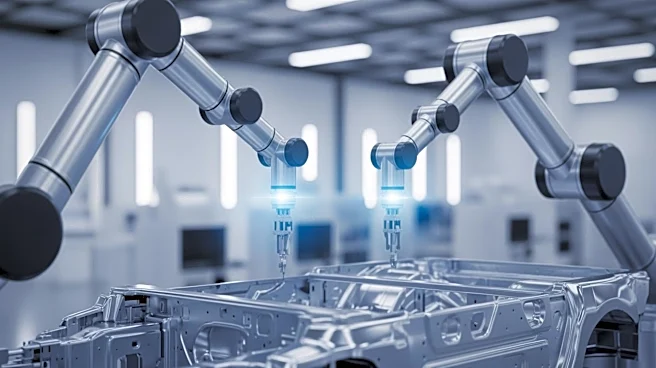
What's Happening?
The integration of deformable materials in manufacturing presents a significant challenge for physical AI systems. Traditional automation struggles with tasks involving fabric and other flexible materials due to their unpredictable behavior. Advances
in vision, simulation, perception, and robot intelligence are moving dexterous manipulation from lab demonstrations toward deployment. The focus is on redesigning manufacturing processes to accommodate robots, using techniques like bonded assembly and purpose-built grippers to handle soft materials. This approach aims to create a controlled environment for learning-based manipulation, enhancing the reliability and scalability of robotic systems.
Why It's Important?
The ability to handle deformable materials is crucial for industries such as apparel, automotive interiors, and aerospace composites. Developing systems that can perceive, reason about contact, and adapt in real time could revolutionize manufacturing, leading to more efficient and flexible production processes. This advancement in physical AI could reduce reliance on human labor for tasks involving soft materials, improving productivity and reducing costs. The research highlights the need for integrated systems that combine robotics, joining methods, and learning-based control to address the challenges posed by deformable materials.
What's Next?
As physical AI systems continue to evolve, manufacturers may increasingly adopt these technologies to enhance their production capabilities. The focus will be on refining the integration of robotics and learning-based control to handle a wider range of materials and tasks. The success of these systems in handling deformable materials could lead to broader applications in various industries, driving innovation and competitiveness in manufacturing.