







What's Happening?
A new dinosaur species, named Doolysaurus huhmini, has been discovered on Aphae Island, South Korea. This marks the first new dinosaur species identified in the country in 15 years and the first to include parts of a dinosaur skull. The discovery was
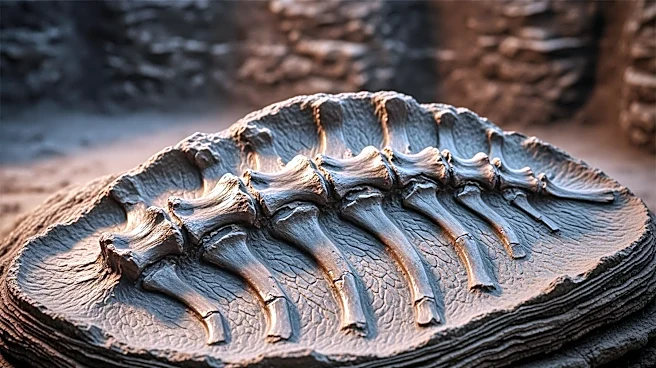
made by a team led by Jongyun Jung, a visiting postdoctoral researcher at the University of Texas's Jackson School of Geosciences. The fossil, initially found in 2023, was encased in rock, revealing only a few bones. However, a micro-CT scan at the University of Texas High-Resolution X-ray Computed Tomography facility uncovered additional hidden bones, including skull fragments. The dinosaur, believed to be a juvenile, was about the size of a turkey and may have been covered in soft, fuzzy filaments. The findings were published in the journal Fossil Record on March 19.
Why It's Important?
The discovery of Doolysaurus huhmini is significant as it adds to the understanding of dinosaur species in East Asia, particularly in South Korea, where actual dinosaur bones are rare compared to fossilized tracks, nests, and eggs. The use of micro-CT scanning technology in this discovery highlights its importance in paleontology, allowing researchers to visualize and study delicate fossils without damaging them. This method could lead to further discoveries in the region, potentially uncovering more hidden fossils. The research also contributes to the broader knowledge of the mid-Cretaceous period, providing insights into the diet and physical characteristics of thescelosaurids, a group of two-legged dinosaurs.
What's Next?
Researchers, including Jongyun Jung, plan to continue exploring Aphae Island and other small islands in South Korea for additional specimens. The team is optimistic that the use of micro-CT technology will lead to more discoveries, potentially revealing new dinosaur species or other significant fossils. The techniques learned from this study are being applied to other fossils in Korea, which may further enhance the understanding of the region's prehistoric biodiversity.
Beyond the Headlines
The discovery of Doolysaurus huhmini not only enriches the scientific community's understanding of dinosaur evolution but also underscores the potential for significant paleontological finds in regions previously underexplored. The use of advanced imaging technology like micro-CT scanning represents a shift in how paleontologists approach fossil excavation and study, allowing for non-invasive exploration of fossils encased in rock. This could lead to a reevaluation of existing fossil collections worldwide, potentially uncovering new insights into ancient ecosystems.