
What's Happening?
The Atacama Cosmology Telescope (ACT) has released its final data, confirming a disparity in measurements of the 'Hubble constant,' which describes the rate of cosmic expansion. This discrepancy, known
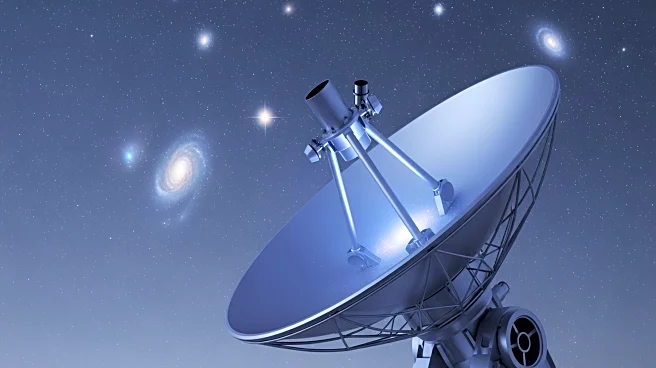
as 'Hubble tension,' arises from different values obtained when measuring the local universe using Type 1a supernovas and the distant cosmos using fossil light. The ACT data supports the existence of this tension, challenging extended models of the universe's evolution and reinforcing the Lambda Cold Dark Matter (LCDM) model. The ACT's observations of the Cosmic Microwave Background (CMB) provide high-resolution polarization maps, complementing previous temperature data from the ESA's Planck spacecraft.
Why It's Important?
The confirmation of 'Hubble tension' by ACT data is significant for cosmology, as it suggests that current models of the universe's evolution may be incomplete. This tension indicates that the universe's expansion rate varies at different distances, prompting a reevaluation of theoretical models. The ACT's findings help eliminate certain extended models, narrowing the scope for future research. Understanding the Hubble constant is crucial for accurately describing the universe's history and predicting its future behavior, impacting fields such as astrophysics and cosmology.
What's Next?
With the ACT data confirming 'Hubble tension,' researchers will focus on refining the LCDM model and exploring new theories to explain the discrepancy. The data provides a foundation for future studies, encouraging collaboration among cosmologists to address the challenges posed by the tension. As new observations and experiments are conducted, scientists aim to develop a more comprehensive understanding of cosmic expansion and its implications for the universe's structure and evolution.
Beyond the Headlines
The ACT's findings highlight the importance of ground-based telescopes in complementing space-based observations, demonstrating the value of diverse approaches in cosmological research. The confirmation of 'Hubble tension' may lead to innovative theories about the universe's expansion, potentially reshaping our understanding of fundamental physics. The ongoing investigation into cosmic expansion underscores the dynamic nature of scientific inquiry, as researchers adapt to new data and refine existing models.