
What's Happening?
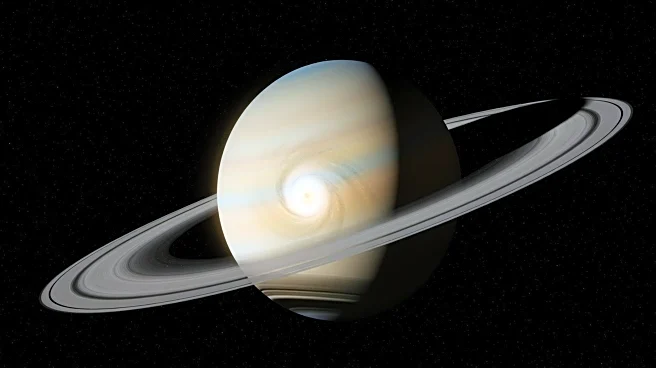
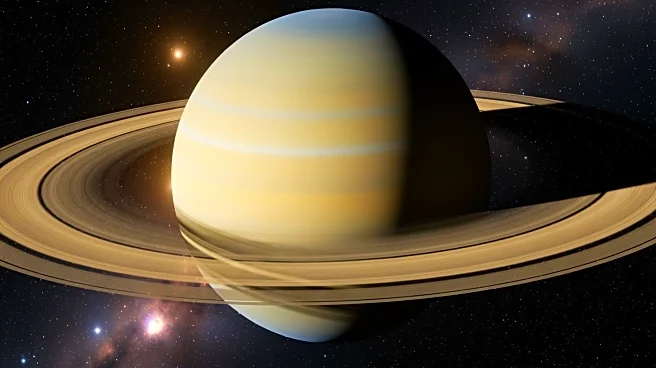
NASA's Hubble Space Telescope and the James Webb Space Telescope have collaborated to provide a new, detailed view of Saturn. The Hubble telescope captured images in visible light, while the Webb telescope used infrared light to reveal chemical activities
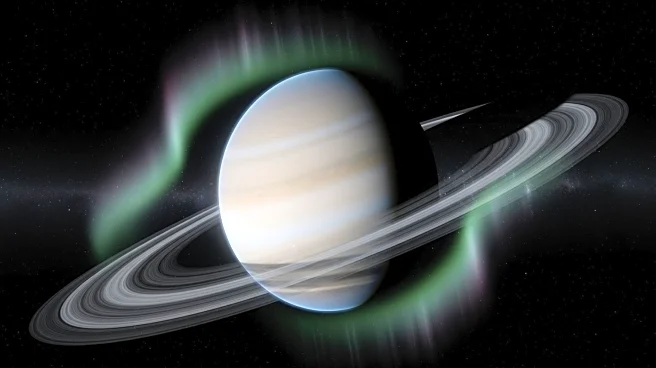
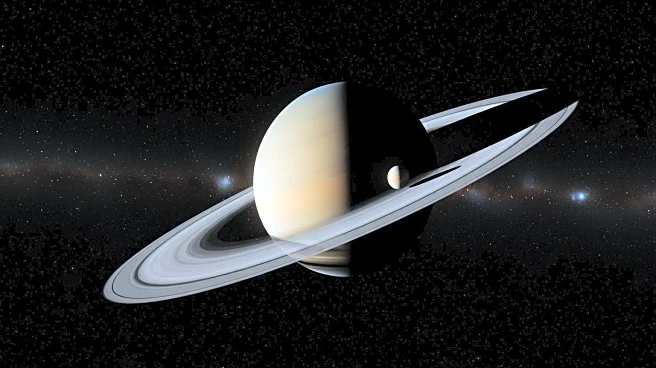
within Saturn's clouds. These images, taken in August and November 2024, show Saturn's iconic hexagon-shaped storm at its north pole, which has been a persistent feature for decades. The images also highlight Saturn's rings, which are composed of reflective water ice, and the planet's atmospheric bands shaped by winds and waves. This collaboration is part of the Outer Planets Atmospheres Legacy (OPAL) program, aimed at monitoring the atmospheric evolution of giant planets.
Why It's Important?
The collaboration between the Hubble and Webb telescopes provides a comprehensive view of Saturn, enhancing our understanding of the planet's atmospheric dynamics. This is significant for the scientific community as it offers insights into fluid dynamics under extreme conditions, which can be applied to other planetary studies. The detailed images of Saturn's atmosphere and rings contribute to ongoing research and may lead to new discoveries about the planet's weather patterns and magnetic field interactions. This collaboration also demonstrates the capabilities of combining different observational technologies to gain a more complete understanding of celestial bodies.
What's Next?
As Saturn's North Pole enters its seasonal winter darkness, future observations may be limited until the 2040s. However, the data collected from this collaboration will continue to be analyzed, potentially leading to new insights into Saturn's atmospheric conditions and magnetic field. The OPAL program will persist in monitoring Saturn and other outer planets, contributing to long-term studies of their atmospheric changes. The success of this collaboration may encourage similar joint efforts in the future, utilizing multiple telescopes to study other planets and celestial phenomena.