




What's Happening?
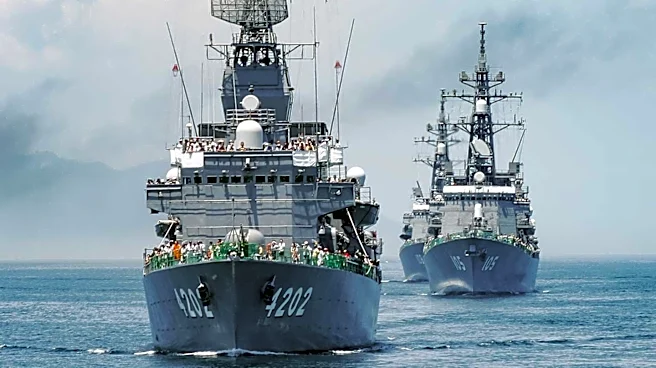
Ukrainian President Volodymyr Zelenskyy has signed three decrees enacting decisions by the National Security and Defense Council of Ukraine to impose sanctions on various Russian entities and individuals. These measures target 20 seagoing vessels identified
as part of Russia's 'shadow fleet,' which are used to export oil, petroleum products, and liquefied gas. These tankers, operating under flags of convenience from Liberia, Marshall Islands, Sierra Leone, Barbados, and Palau, transport Russian oil to countries like India, Egypt, and Turkey, providing crucial revenue for the Russian budget to finance the war against Ukraine. Additionally, sanctions have been imposed on 29 Russian citizens and 29 Russian companies. These companies are involved in supply chains for high-precision industrial equipment, electronics, and components used in missile and drone manufacturing, as well as dual-use goods, military-industrial complex research, and IT solutions for military enterprises. The sanctions also target enterprises of the 'Rostec' corporation, which is described as the industrial core of Russia's war machine, producing up to 80% of weapons and military equipment used against Ukraine, including Iskander and Kinzhal missiles and attack drones. Furthermore, restrictions have been placed on 10 Russian and Ukrainian individuals accused of spreading disinformation and Russian propaganda.
Why It's Important?
These sanctions are a critical component of Ukraine's strategy to weaken Russia's military and economic capabilities, directly impacting its ability to wage war. By targeting Russia's shadow fleet, Ukraine aims to disrupt a significant source of revenue that directly funds military operations. The inclusion of enterprises within Russia's military-industrial complex, particularly those linked to 'Rostec,' seeks to degrade Russia's capacity to produce and deploy advanced weaponry. This move is intended to create tangible economic pressure and logistical challenges for the Russian war effort. The sanctions also highlight the international nature of Russia's evasion tactics, as tankers operate under various flags to circumvent existing restrictions. By sanctioning propagandists, Ukraine is also attempting to counter the information warfare aspect of the conflict, aiming to limit the spread of disinformation and undermine support for Russia's aggression. Ukraine's stated intention to share this information with international partners underscores a broader effort to synchronize sanctions across jurisdictions, potentially amplifying their global impact and increasing pressure on Russia.
What's Next?
Ukraine plans to provide all relevant information to its international partners to facilitate the synchronization of these sanctions across various jurisdictions. This collaborative effort aims to enhance the effectiveness of the measures by creating a more unified front against Russian economic and military activities. The success of these sanctions will depend on the willingness and ability of other nations to adopt similar restrictions and enforce them rigorously. The continued monitoring of Russia's shadow fleet and its supply chains will be crucial to identify new evasion tactics and adapt future sanctions accordingly. The impact on Russia's oil exports and military production will be closely watched, as will any potential retaliatory measures from Russia. The ongoing diplomatic efforts by Ukraine to garner international support for these sanctions will also play a significant role in their long-term efficacy. The call by President Zelenskyy for the United States to support Senator Graham's sanctions package indicates a desire for continued and strengthened U.S. involvement in these efforts.
Beyond the Headlines
The imposition of these sanctions by Ukraine reflects a growing trend of nations directly targeting the logistical and financial underpinnings of their adversaries' war efforts. This approach moves beyond traditional broad economic sanctions to more granular targeting of specific assets and networks. The focus on the 'shadow fleet' highlights the evolving nature of economic warfare, where actors actively seek to obscure their activities through complex ownership structures and flags of convenience. This raises broader questions about maritime law, international accountability for vessels operating outside traditional regulatory frameworks, and the challenges of enforcing sanctions in a globalized economy. Furthermore, sanctioning propagandists underscores the recognition of information warfare as a critical front in modern conflicts, blurring the lines between military, economic, and ideological battles. The long-term implications could include increased international cooperation on intelligence sharing to track illicit financial flows and shipping, as well as a re-evaluation of international maritime regulations to prevent the exploitation of loopholes by sanctioned entities.