
What's Happening?
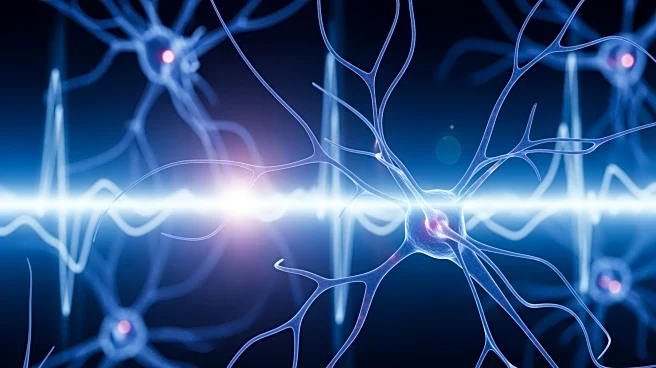
Researchers at the Paris-Saclay Institute of Neuroscience (NeuroPSI) have proposed a new explanation for the recurrent firing patterns of neurons in the cerebral cortex. Traditionally, these patterns were
thought to arise from strong connections between neurons acting as 'pattern-completion' units. However, the new study suggests that cortical neurons are organized into modules connected to core neurons, which guide the flow of activity in the brain. This research, published in Nature Neuroscience, involved analyzing various brain-related datasets using imaging and electrical activity detection methods. The findings indicate that reproducible activity patterns do not involve strongly interconnected neurons but rather a hierarchical modularity with core neurons serving as high-information-flow nodes.
Why It's Important?
This new understanding of neuronal activity patterns could significantly impact the study of brain development and disorders characterized by poor sensorimotor coordination. By redefining the structural and dynamical basis of cortical activity, the research offers insights into how the brain coordinates sensory information with movement. This could lead to advancements in artificial neural networks and computational models inspired by the brain's organization. The study challenges long-standing interpretations of cortical activity, potentially leading to new approaches in neuroscience research and applications in technology and medicine.
What's Next?
Future experiments and analyses are needed to validate the hypothesis proposed by the NeuroPSI researchers. If confirmed, this new explanation could deepen the understanding of brain function and inform the development of innovative treatments for neurological disorders. Additionally, the findings may influence the design of artificial intelligence systems, enhancing their ability to mimic human brain functions. Researchers will likely continue to explore the implications of hierarchical modularity in cortical networks and its role in sensorimotor coordination.