



What's Happening?
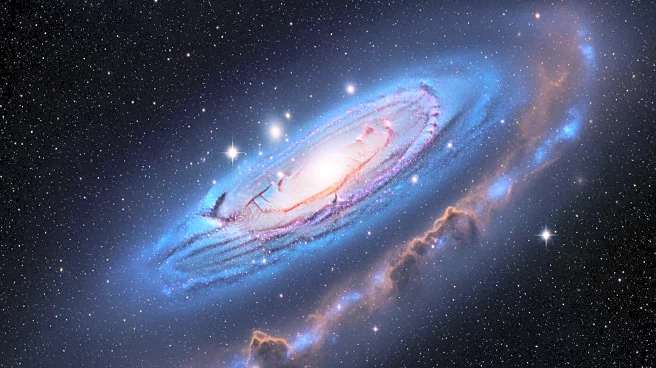
The NASA/ESA Hubble Space Telescope has captured a striking image of the spiral galaxy NGC 1792, located over 50 million light-years away in the constellation Columba. This galaxy is classified as a starburst galaxy, characterized by its intense star formation
activity. The image reveals the galaxy's bright center surrounded by flocculent spiral arms rich in star-forming regions. NGC 1792 is in close proximity to a larger galaxy, NGC 1808, and the gravitational interaction between them is believed to have stirred up gas reserves, leading to a surge in star formation. The new data collected throughout 2025 provides a deeper insight into the galaxy's tumultuous activity, highlighting Hydrogen-alpha emissions from dense hydrogen clouds where new stars are forming.
Why It's Important?
The study of NGC 1792 offers astronomers valuable insights into the complex interactions between gas, star clusters, and supernovae within galaxies. Understanding these processes is crucial for comprehending the lifecycle of galaxies and the formation of stars. The gravitational interactions observed in NGC 1792 can shed light on how galaxies evolve and influence each other. This research contributes to the broader field of astrophysics by enhancing knowledge about starburst galaxies, which are key to understanding cosmic phenomena such as star formation rates and galactic dynamics. The findings may also inform future studies on galaxy formation and evolution.
What's Next?
Astronomers will continue to analyze the data collected by the Hubble Space Telescope to further understand the dynamics of NGC 1792 and its interaction with NGC 1808. Future observations may focus on identifying specific star-forming regions and studying the impact of gravitational forces on star formation. These studies could lead to new discoveries about the behavior of starburst galaxies and their role in the universe. Additionally, ongoing research may explore the implications of these interactions for the broader cosmic environment, potentially influencing theories about galaxy formation and the distribution of matter in the universe.
Beyond the Headlines
The observations of NGC 1792 highlight the importance of international collaboration in space exploration, as the Hubble Space Telescope is a joint project between NASA and the European Space Agency (ESA). This partnership exemplifies how global cooperation can advance scientific knowledge and technological innovation. The study of starburst galaxies like NGC 1792 also raises questions about the long-term impact of star formation on galactic structures and the potential for future cosmic events such as supernovae. These insights contribute to the ongoing dialogue about the universe's evolution and the forces shaping it.