






What's Happening?
An international team of climate scientists has published a study in Science Advances, confirming that global sea level rise has been accelerating since 1960. The research, led by scientists from the Chinese Academy of Sciences and involving experts from various
international institutions, reveals that the global average sea level has risen by 2.06 millimeters per year since 1960, with the rate doubling to 3.94 millimeters per year between 2005 and 2023. The primary drivers of this rise are ocean warming, which accounts for 43% of the increase, and the melting of glaciers and ice sheets. The study highlights the significant role of human-induced climate change in this phenomenon, emphasizing the relentless nature of sea level rise due to the expansion of ocean water and the addition of meltwater from ice.
Why It's Important?
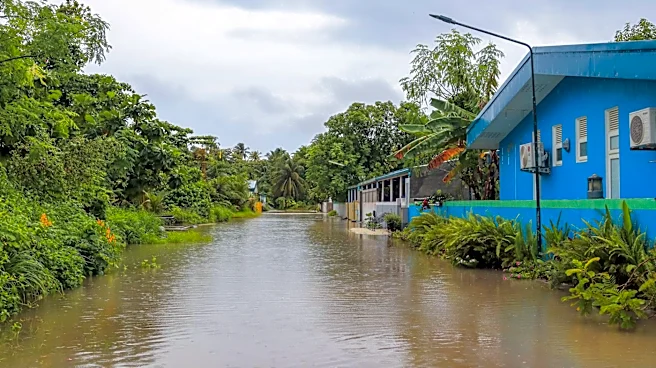
The findings underscore the critical impact of human activities on climate change and its consequences, particularly sea level rise. This acceleration poses significant risks to coastal communities, infrastructure, and ecosystems. As sea levels continue to rise, the potential for increased flooding, erosion, and habitat loss becomes more pronounced, affecting millions of people worldwide. The study's confirmation of the causes of sea level rise enhances the understanding of climate change impacts, providing a basis for policymakers to develop more effective mitigation and adaptation strategies. The research also highlights the importance of continued investment in climate science to improve predictive models and inform global efforts to address climate change.
What's Next?
The study suggests that even if greenhouse gas emissions are stabilized, the inertia of the ocean and ice systems means that sea level rise will persist for centuries. This long-term trend necessitates proactive planning and adaptation measures by governments and communities to mitigate the impacts on vulnerable coastal areas. Future research will likely focus on refining models to predict regional variations in sea level rise and developing innovative solutions to protect coastal infrastructure and ecosystems. International collaboration and policy initiatives will be crucial in addressing the challenges posed by ongoing sea level rise.