






What's Happening?
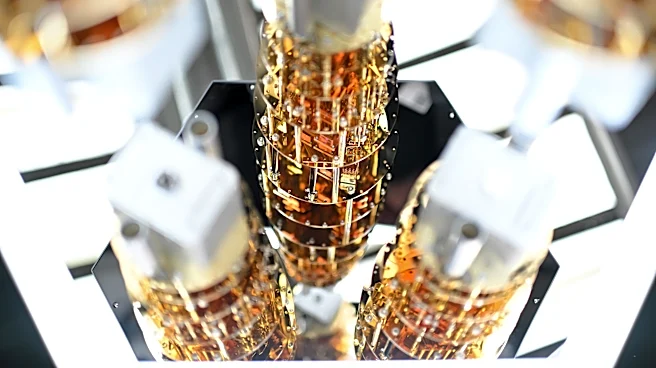
Researchers from Rutgers, IBM, and collaborating institutions have demonstrated a significant advancement in quantum computing by enabling a quantum computer to repeatedly check and reset its own components while operating. This experiment, conducted
on a 156-qubit IBM Quantum Heron processor, represents one of the largest demonstrations of real-time quantum feedback control. Unlike conventional computers that use bits (0s or 1s), quantum computers utilize qubits, which can exist in multiple states simultaneously. This property, while powerful, makes quantum information highly susceptible to errors from heat, stray signals, or hardware imperfections. The research showed that by frequently checking and resetting qubits, the system could transition from chaotic behavior to a controllable, orderly state, a critical step towards building fault-tolerant quantum computers. This capability is essential because quantum information cannot be simply copied, and direct measurement can alter or destroy its state, making error correction a complex challenge.
Why It's Important?
This breakthrough is crucial for the future of quantum computing, particularly for its potential impact on U.S. industries and scientific research. Fault-tolerant quantum computers, capable of identifying and correcting errors in real-time, are necessary to unlock the full potential of this technology. Such machines could revolutionize fields like medicine by designing better drugs and batteries, simulating complex molecules and materials, and advancing artificial intelligence programs beyond the capabilities of current supercomputers. The ability to control chaotic quantum behavior and maintain qubit integrity is a foundational step toward practical quantum applications. Companies like IBM are at the forefront of this research, positioning the U.S. as a leader in the development of this transformative technology, which could generate substantial economic value and solve problems currently intractable for conventional computing.
What's Next?
The immediate next steps involve further refining quantum error correction techniques and scaling up these capabilities to larger quantum systems. The research team aims to continue exploring how frequently checks and resets need to occur to maintain control and prevent error accumulation. The long-term goal is to build a truly fault-tolerant quantum computer, a device that can perform complex calculations reliably despite inherent qubit instability. This will involve continued collaboration between academic institutions and industry leaders like IBM. The success of this research also opens avenues for exploring other quantum phenomena, such as the observed phase transition from chaos to control, which could lead to new theoretical understandings and practical applications in quantum physics. The development of more robust quantum hardware and software will be critical for transitioning quantum computing from laboratory experiments to commercial applications.
Beyond the Headlines
The ability to control quantum chaos and achieve order from disorder has profound implications beyond just computing. This phenomenon, where a slight change in intervention frequency dramatically shifts a system's behavior, mirrors complex systems in nature and could offer new insights into various scientific disciplines. The 'no-cloning theorem' in quantum mechanics, which prevents direct copying of quantum states, highlights a fundamental difference from classical computing and underscores the unique challenges and opportunities in quantum information processing. The ethical considerations surrounding the immense power of quantum computing, particularly in areas like cryptography and AI, will also become increasingly relevant as the technology matures. This research represents a step towards a future where quantum computers could not only solve complex scientific problems but also reshape our understanding of information, reality, and the limits of computation.