





What's Happening?
Researchers at the University of Osaka, in collaboration with Tokai Rika Co., Ltd. and the University of California San Diego, have developed an ultra-wideband (UWB) radio-based positioning method designed to precisely align electric vehicles (EVs) with wireless
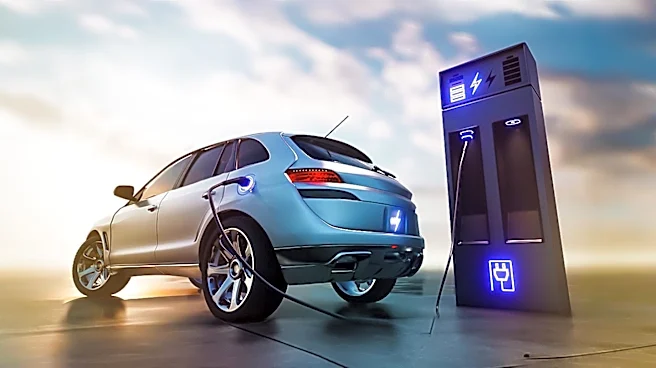
charging pads. This technology, detailed in the IEEE Open Journal of Vehicular Technology on August 26, 2026, utilizes UWB radio signals, similar to those found in some digital car keys, to determine the exact position and orientation of a vehicle's charging coil relative to the ground-mounted charging pad. The system employs a two-step process: initially using radio-signal travel times for an approximate location, then refining this with phase differences—tiny shifts in radio wave arrival—to achieve high accuracy. Signal distortions specific to each installation are pre-measured and corrected. Laboratory tests with a scaled-down vehicle mockup demonstrated impressive precision, achieving median errors of just 2.32 millimeters in position and 0.25 degrees in orientation. This level of accuracy is crucial for efficient wireless charging, as even slight misalignments can reduce charging efficiency and increase charging times.
Why It's Important?
This development is significant for the future of electric vehicle infrastructure, particularly in the U.S., where EV adoption is rapidly increasing. Precise alignment is a major hurdle for widespread wireless EV charging, as current magnetic positioning systems often require close proximity, and camera-based systems can be hindered by environmental factors like rain or dirt. By offering millimeter-level accuracy, this UWB radio method could make wireless charging more reliable and user-friendly, removing a key barrier to its broader implementation. This technology is especially critical for autonomous vehicles and robotaxis, which require automated recharging without human intervention. Enhanced efficiency in charging could lead to faster charging times and reduced energy waste, benefiting both consumers and the energy grid. The U.S. automotive industry and energy sector stand to gain from a more seamless and efficient EV charging experience, potentially accelerating the transition to electric transportation and supporting the growth of autonomous vehicle fleets.
What's Next?
The immediate next steps for this technology involve further testing with full-sized vehicles, conducting experiments outdoors, and evaluating its performance during actual power transfer. While laboratory results are promising, real-world conditions present additional challenges that need to be addressed. The researchers hope this method will pave the way for a future where EVs can charge as effortlessly as smartphones on wireless pads. Successful implementation could lead to the integration of this UWB positioning system into future EV models and charging infrastructure. This would require collaboration between automotive manufacturers, charging infrastructure providers, and technology developers. The potential for automated, precise alignment could also influence the design of future autonomous vehicle charging stations, making them more efficient and less reliant on human oversight. The continued refinement and commercialization of this technology could establish a new standard for wireless EV charging accuracy.
Beyond the Headlines
Beyond the immediate practical benefits, this UWB radio technology could have broader implications for urban planning and smart city development. With highly efficient and automated wireless charging, cities could integrate charging pads more seamlessly into public spaces, such as parking lots and roadways, without the need for visible charging cables or complex manual alignment. This could enhance the aesthetic appeal of urban environments and improve accessibility for all vehicle types, including those with mobility challenges. Furthermore, the precision offered by UWB could open doors for more sophisticated energy management systems, allowing for optimized power transfer and potentially dynamic charging scenarios where vehicles charge while in motion. The underlying UWB technology, already used in digital car keys, demonstrates its versatility and potential for integration into various automotive applications, hinting at a future where vehicles are more interconnected and intelligent in their interactions with infrastructure.