





What's Happening?
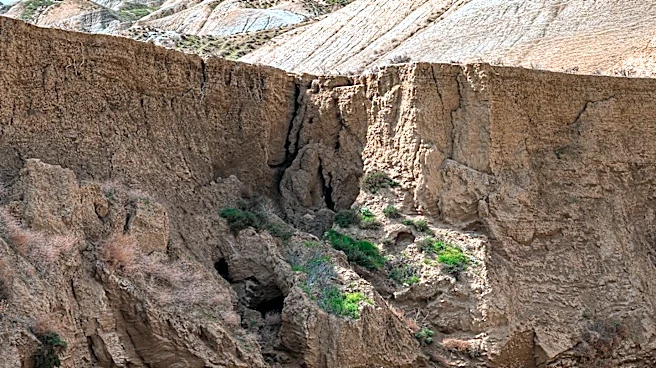
New research from San Jose State University (SJSU) suggests that the San Andreas Fault is slipping faster than previously understood. SJSU Professor Kim Blisniuk, who spoke with ABC7 Eyewitness News, explained that their work at Sanborn County Park indicates
a constant slip rate along the fault over a 10,000-year period, similar to rates observed in the north coast section of the fault. This finding challenges previous assumptions that the slip rate might decrease in certain sections. Faults that move faster are generally associated with more frequent earthquakes. The research, which has not yet been published or peer-reviewed, serves as a reminder for residents to be prepared for seismic activity. Historically, significant earthquakes, including the 1989 Loma Prieta and 1906 San Francisco earthquakes, have occurred along the San Andreas Fault zone.
Why It's Important?
This research is crucial for understanding seismic risk in California, particularly for communities located along the San Andreas Fault. A faster slip rate implies a potentially higher frequency of earthquakes, which could necessitate a re-evaluation of earthquake preparedness strategies, building codes, and infrastructure resilience. For residents and emergency services, this information reinforces the importance of maintaining earthquake preparedness kits and emergency plans. The San Andreas Fault is one of the most active and well-known fault lines in the world, and any new data regarding its behavior has significant implications for public safety and urban planning in a densely populated state like California. The findings could also influence insurance policies and real estate development in high-risk areas, as a clearer understanding of seismic activity can lead to more informed risk assessments.
What's Next?
The next step for this research will be its publication and peer review, which will allow the scientific community to scrutinize and validate the findings. If confirmed, this new understanding of the San Andreas Fault's slip rate could lead to updated seismic hazard models and risk assessments by geological surveys and emergency management agencies. Public awareness campaigns about earthquake preparedness may also be intensified, urging residents to review and update their emergency plans and supplies. While the research does not predict an immediate earthquake, it underscores the continuous need for vigilance and readiness in earthquake-prone regions. Further studies may also be initiated to explore the implications of a constant slip rate across different segments of the fault and its potential impact on the timing and magnitude of future seismic events.
Beyond the Headlines
The revelation of a potentially faster and more constant slip rate along the San Andreas Fault highlights the dynamic and complex nature of geological processes. It challenges previous models and emphasizes the ongoing need for scientific research to refine our understanding of natural hazards. This kind of scientific advancement can have profound societal impacts, influencing not only immediate safety measures but also long-term urban development and resource allocation. The comparison to insurance – where one hopes never to use it but is prepared – aptly describes the philosophy behind earthquake preparedness. This research serves as a powerful reminder that living in seismically active regions requires a proactive and continuous commitment to understanding and mitigating risks, fostering a culture of resilience in the face of unpredictable natural phenomena.