




What's Happening?
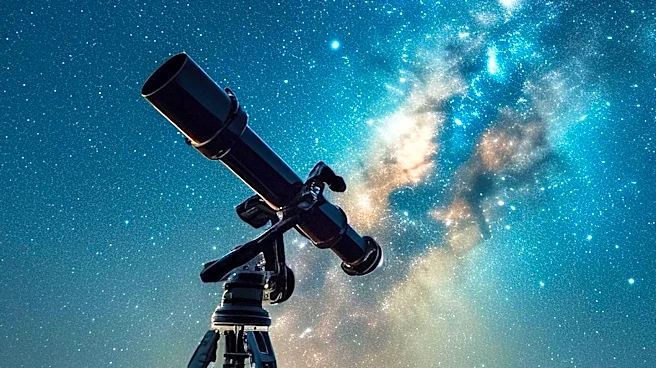
Bowling Green State University's Department of Physics & Astronomy is offering public stargazing sessions at its rooftop observatory. These events provide an opportunity for the public to view celestial objects through both a 0.5-meter research-grade
telescope and smaller amateur telescopes. Attendees will also learn how to identify major constellations and visible planets. The observatory is located on the roof of the Physical Sciences Laboratory Building, accessible via elevator. Stargazing sessions are scheduled on Sundays, Tuesdays, and Fridays, with specific times varying by month. For September 4 through October 2, sessions are at 9 p.m., and from October 6 through November 6, they are at 8 p.m. These sessions are free and open to the public. Participants are advised to dress warmly as the rooftop can be colder and windier than ground level. The use of phones for flash-free pictures or astronomy apps is permitted, but phone lights should not be used to preserve dark adaptation for optimal night sky viewing. Stargazing is contingent on clear weather conditions; sessions will be canceled if it is snowing, raining, foggy, cloudy, or even partly cloudy. A recorded message is available one hour before the scheduled start time to confirm if a session will be held.
Why It's Important?
These public stargazing events are important for several reasons, primarily in promoting science education and community engagement. By providing access to research-grade telescopes and expert guidance, Bowling Green State University is making astronomy accessible to a broader audience, potentially inspiring interest in STEM fields among students and the general public. Such initiatives can foster a greater appreciation for scientific inquiry and the wonders of the universe. For the local community, these events offer a unique recreational and educational activity that is both free and enriching. They also highlight the university's commitment to public outreach and its role as a cultural and educational resource. The emphasis on weather-dependent scheduling underscores the practical realities of astronomical observation, teaching participants about the conditions necessary for clear sky viewing. This direct experience can be far more impactful than theoretical learning, helping to demystify scientific concepts and make them tangible.
What's Next?
The public stargazing sessions at Bowling Green State University's rooftop observatory are scheduled to continue on Sundays, Tuesdays, and Fridays through November 6, 2026. Beyond these regular sessions, there may also be additional stargazing opportunities following evening Planetarium shows, weather permitting. Individuals interested in attending should call the provided number one hour before the scheduled start time to confirm if the session will proceed, as clear weather is a prerequisite. The university will likely continue to monitor weather conditions closely to ensure optimal viewing experiences and the safety of attendees. Future plans for the observatory may include expanding the types of celestial objects observed or incorporating new educational components based on public interest and technological advancements. The ongoing success of these events could lead to their continuation in subsequent academic years, further solidifying the university's role in public science education.
Beyond the Headlines
The offering of free public stargazing events by Bowling Green State University extends beyond simple educational outreach; it taps into a fundamental human curiosity about the cosmos. In an increasingly digital world, providing direct, unmediated experiences with the night sky can serve as a powerful antidote to screen-based entertainment, encouraging a deeper connection with the natural world and scientific discovery. These events also subtly reinforce the value of public universities as centers of knowledge and community service, demonstrating how academic institutions can contribute to the cultural and intellectual life of their regions. The emphasis on dark adaptation and the avoidance of phone lights during stargazing sessions highlights a broader issue of light pollution and its impact on astronomical observation, subtly educating the public on responsible viewing practices. This initiative fosters a sense of shared wonder and collective learning, transcending typical classroom settings and making scientific exploration an accessible and engaging activity for all ages.