
What's Happening?
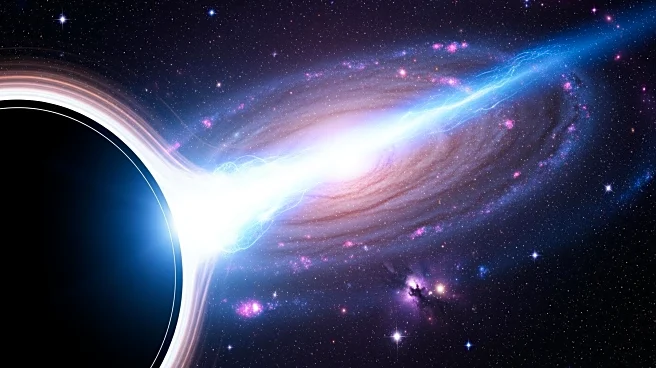
Astronomers have detected a massive, invisible object 11 billion light-years away, identified through gravitational lensing. Led by Simona Vegetti from the Max Planck Institute for Astrophysics, the team
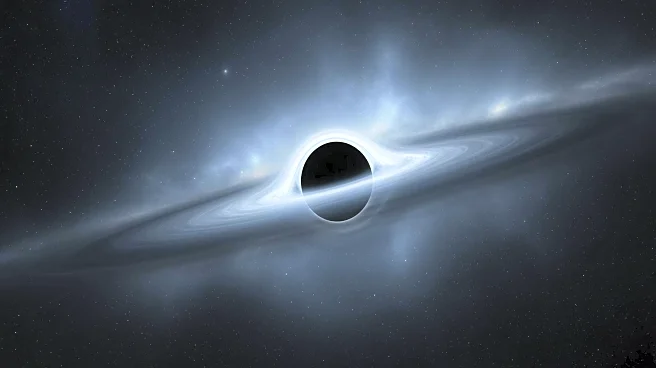
found the object within a galaxy cluster, exhibiting a dense core and an irregular structure. The object, weighing a million times the mass of the Sun, does not emit light, making it the most distant mass discovered through gravitational lensing alone. Its unique profile challenges current astrophysical models, as it does not fit into known categories like dwarf galaxies or dark matter halos.
Why It's Important?
This discovery could have profound implications for our understanding of dark matter and galaxy formation. The object's unusual structure suggests the existence of previously unknown cosmic phenomena, potentially requiring new theoretical frameworks. It raises questions about the prevalence of such objects in the universe and their role in cosmic evolution. The findings also highlight the limitations of current dark matter models, prompting further investigation into the nature of these mysterious structures.
What's Next?
Astronomers plan to use infrared telescopes, including the James Webb Space Telescope, to search for any light emissions from the object at different wavelengths. These observations could provide crucial insights into its nature and composition. If no emissions are detected, scientists may need to consider the possibility of a new category of cosmic objects, further expanding our understanding of the universe.