






What's Happening?
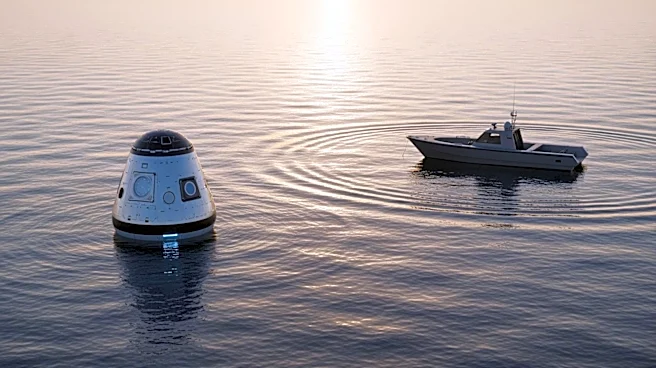
NASA's Artemis II mission is emphasizing the importance of recovery operations and the human element in space exploration. Dan Florez, a NASA test director for the Exploration Ground Systems Program, is playing a crucial role in coordinating rescue and recovery operations for the mission.
The Artemis II mission, which launched on April 1, 2026, involves a 10-day journey around the Moon with astronauts Reid Wiseman, Victor Glover, Christina Koch, and Jeremy Hansen. Florez and his team are responsible for ensuring the safe return of the crew, coordinating with the U.S. military and the Human Spaceflight Support Office within the Air Force. The mission includes extensive testing and validation of recovery operations, with the Artemis II crew participating in these tests to provide feedback and improve procedures.
Why It's Important?
The focus on recovery operations and the human element in the Artemis II mission highlights NASA's commitment to ensuring astronaut safety during space missions. This approach is crucial as it addresses the complexities of human spaceflight, including emergency scenarios and the need for rapid response in case of an abort. The collaboration with the U.S. military and the Air Force's Human Spaceflight Support Office underscores the importance of inter-agency partnerships in achieving mission success. The insights gained from these operations will inform future missions, contributing to the advancement of human space exploration and the development of more robust safety protocols.
What's Next?
As the Artemis II mission progresses, NASA will continue to refine its recovery operations and incorporate feedback from the crew to enhance safety measures. The successful completion of this mission will pave the way for future Artemis missions, including the highly anticipated Artemis III, which aims to land astronauts on the Moon. The ongoing collaboration with military partners will likely expand, providing additional support for upcoming missions. NASA's focus on the human element will also drive further research into the physiological and psychological impacts of space travel, informing the design of future spacecraft and mission protocols.