
What's Happening?
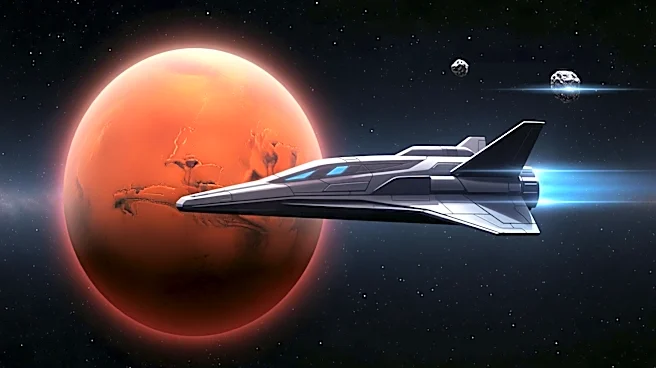
NASA's Psyche spacecraft is set to perform a close flyby of Mars this week, utilizing the planet's gravity to gain momentum for its journey to a rare metal asteroid. The spacecraft, named after its target,
will pass within 2,800 miles of Mars, equivalent to the distance between the U.S. east and west coasts. This maneuver is part of its six-year mission, which began with its launch in 2023. The spacecraft is equipped with science instruments that will be active during the Mars pass, capturing thousands of images for both scientific and operational purposes. The mission aims to study the asteroid Psyche, believed to be the exposed nickel and iron core of a protoplanet, offering insights into the early solar system and planetary formation.
Why It's Important?
The Psyche mission is significant as it targets a metal-rich asteroid, which is a rarity among the millions of rocky and icy bodies in the asteroid belt. By studying Psyche, scientists hope to gain a better understanding of the building blocks of planet formation and the conditions that led to the development of life on Earth. The mission's findings could provide valuable data on the composition and history of the solar system, potentially influencing future space exploration and resource utilization strategies. The use of solar electric propulsion and the gravity assist from Mars also demonstrate advanced space navigation techniques that could be applied to future deep-space missions.
What's Next?
Following the Mars flyby, the Psyche spacecraft will continue its journey to the asteroid belt, with an expected arrival at the asteroid in 2029. Once there, it will enter orbit around Psyche for a two-year study period. During this time, the spacecraft will conduct detailed observations and analyses of the asteroid's surface and composition. The mission's success could pave the way for future missions targeting other metal-rich asteroids, potentially leading to new discoveries about the solar system's history and the potential for mining valuable resources in space.