
What's Happening?
On December 18, 2025, the interstellar comet 3I/ATLAS is making its closest approach to Earth, approximately 1.8 astronomical units away, which is about 170 million miles. This event marks a significant
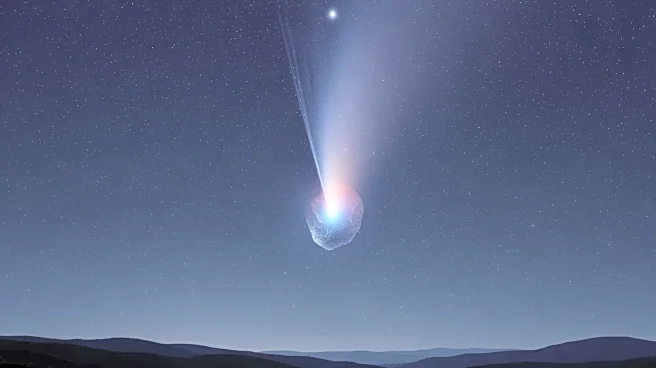
opportunity for astronomers and the public to observe a rare interstellar object, only the third of its kind confirmed to pass through our solar system. The comet, traveling at speeds up to 153,000 mph, will be visible in the pre-dawn sky near the constellation Leo. Although not visible to the naked eye, it can be observed using telescopes or through online livestreams, such as the one provided by the Virtual Telescope Project. The comet's approach is generating interest due to its unique origin and the scientific insights it may offer about the chemistry and building blocks of other star systems.
Why It's Important?
The approach of comet 3I/ATLAS is significant for both scientific research and public engagement with astronomy. For scientists, the comet presents a rare chance to study an object from another star system, potentially offering clues about the formation and composition of planets beyond our solar system. The data collected could enhance our understanding of interstellar objects and their trajectories. For the public, the event provides an opportunity to engage with space science, as livestreams and viewing guides make the comet accessible to a wider audience. This event underscores the importance of international collaboration in space observation and the role of technology in making astronomical phenomena accessible to the public.
What's Next?
Following its closest approach, comet 3I/ATLAS will continue on a hyperbolic trajectory, eventually leaving the solar system. Observations will continue as the comet remains visible into spring 2026, although it will gradually fade as it moves away. Scientists will analyze the data collected during this period to gain further insights into its composition and behavior. The event may also inspire future missions and research focused on interstellar objects, highlighting the need for continued investment in space observation technologies and international scientific collaboration.