






What's Happening?
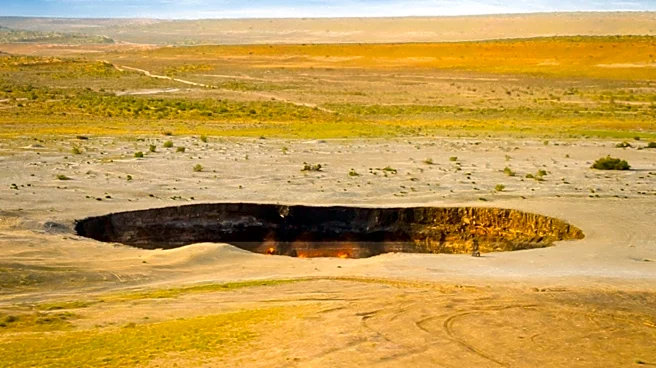
In late 2023, amateur astronomer Joël Lapointe discovered a circular depression in the landscape of northern Quebec while planning a road trip using Google Maps. Initially skeptical of his find, Lapointe reached out to experts, leading to a French research
center's interest in the site. The depression, located about 100 kilometers north of the town of Magpie, was confirmed to be a meteorite impact crater by a team led by Gordon Osinski, a professor of earth sciences at Western University. The crater, named Uhackatik in collaboration with the local Indigenous community, is approximately 25 kilometers in diameter and dates back 390 million years, a time when life on land was just beginning to emerge.
Why It's Important?
The discovery of the Uhackatik crater is significant as it adds to the limited number of known impact craters on Earth, providing valuable insights into the planet's geological history. Such craters are rare, with only one or two being identified globally each year. This find not only highlights the potential for amateur astronomers to contribute to scientific discoveries but also underscores the importance of collaboration between scientists and local communities. The crater's age offers a glimpse into a prehistoric era, enhancing our understanding of Earth's ancient environments and the events that have shaped its surface.
What's Next?
Following the confirmation of the crater, further studies may be conducted to explore its geological features and gather more data on the impact event. The collaboration with the Ekuanitshit Innu council in naming the crater suggests ongoing engagement with Indigenous communities, which could lead to more inclusive scientific practices. Additionally, the discovery may inspire other amateur astronomers to pursue their observations, potentially leading to more findings that could enrich our understanding of Earth's history.
Beyond the Headlines
The discovery of the Uhackatik crater illustrates the power of modern technology, such as satellite maps, in uncovering hidden geological features. It also emphasizes the role of curiosity and persistence in scientific exploration, demonstrating that significant contributions can come from outside the professional scientific community. This event may encourage a broader public interest in geology and space science, fostering a culture of exploration and discovery.