
What's Happening?
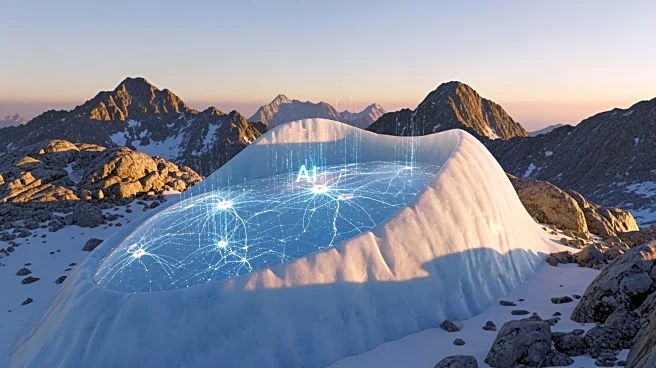
Brett Storoe, an alum of Neuqua Valley High School, is leveraging artificial intelligence to create artificial glaciers, known as ice stupas, in Chile. These man-made glaciers are designed to store water
during the winter and release it in the summer, addressing water scarcity issues in the region. Storoe, now a college junior at the Milwaukee School of Engineering, became involved in this project through an AI club. His work involves developing an algorithm that determines optimal locations for building these ice stupas. The project is a collaboration with Nilus, a Chilean startup focused on using AI to restore ice glaciers. Storoe's algorithm uses weather data to optimize the growth of these glaciers, which are formed by channeling water from higher altitudes and spraying it into subzero air to create ice formations.
Why It's Important?
This initiative is significant as it addresses the critical issue of water scarcity in Chile, a problem exacerbated by climate change. By using AI to create artificial glaciers, the project provides a sustainable solution to water shortages, particularly during the dry summer months. The success of this project could serve as a model for other regions facing similar challenges. Additionally, it highlights the potential of AI in environmental engineering, showcasing how technology can be harnessed to solve real-world problems. For Storoe and his peers, this project also demonstrates the impact that young engineers can have on global issues, encouraging innovation and collaboration across borders.
What's Next?
Storoe plans to continue his work with Nilus as part of his senior capstone project, aiming to enhance the algorithm to predict the volume of ice stupas on a larger scale. This involves transitioning from analyzing 2D images to understanding the glaciers' volume in a 3D context. The ongoing collaboration between the Milwaukee School of Engineering and Nilus may lead to further advancements in the technology used to create and manage these artificial glaciers. As the project progresses, it could attract attention from other organizations and governments interested in adopting similar solutions for water management.