
What's Happening?
Researchers from the Institute of Oceanology of the Chinese Academy of Sciences have uncovered how deep-sea supergiant isopods manage to survive for extended periods without food. These isopods, known
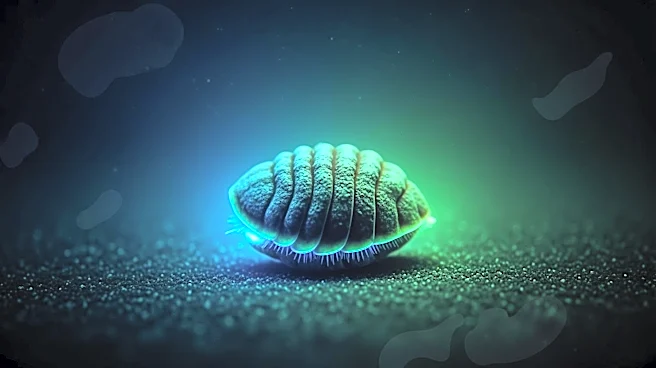
for their significant body size, inhabit nutrient-poor environments in the deep sea. The study, published in the journal Cell, reveals that these isopods employ a dual survival strategy: an enlarged stomach capable of storing large quantities of food and a remarkably low basal metabolic rate (BMR). The research involved analyzing two species of isopods from different ocean depths, revealing that their stomachs can occupy up to two-thirds of their body, allowing them to store and slowly digest food over time. Additionally, a horizontally transferred gene, ND1, plays a crucial role in their energy metabolism, helping them balance the high energy demands of their size with the need for metabolic suppression in their extreme environment.
Why It's Important?
The findings provide significant insights into how life can adapt to extreme environments, offering a new understanding of energy allocation strategies in deep-sea organisms. This research not only sheds light on the survival mechanisms of deep-sea isopods but also presents a broader paradigm for studying how organisms balance growth and survival under harsh conditions. The discovery of the ND1 gene's role in energy metabolism could have implications for understanding metabolic processes in other species, potentially influencing fields such as evolutionary biology and biotechnology. The study highlights the importance of horizontal gene transfer and epigenetic modifications in enabling organisms to thrive in challenging environments, which could inspire new approaches in genetic engineering and conservation efforts.
What's Next?
Future research may focus on exploring the potential applications of these findings in biotechnology and conservation. Understanding the mechanisms behind the isopods' survival strategies could lead to innovations in energy metabolism management in other organisms, including humans. Additionally, further studies could investigate the prevalence of similar survival strategies in other deep-sea species, potentially uncovering new aspects of marine biodiversity and adaptation. The role of the ND1 gene and its regulation through epigenetic modifications may also be explored in other contexts, providing deeper insights into genetic adaptation and resilience.