
What's Happening?
The Voynich manuscript, a mysterious 15th-century book, has long puzzled scholars due to its undeciphered text and unusual illustrations. A recent study proposes that the manuscript's text may have been
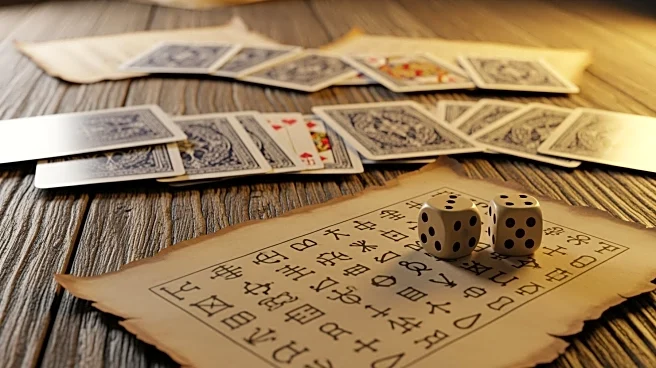
created using a cipher involving cards and dice, known as the 'Naibbe' cipher. This theory, presented by science journalist Michael Greshko in the journal Cryptologia, suggests that the manuscript's text was encoded using a method inspired by a 14th-century Italian card game. The manuscript, which contains about 38,000 words in an unknown language, is housed at Yale University. Despite numerous attempts, including advanced machine learning techniques, the manuscript's code remains unbroken. Greshko's Naibbe cipher offers a potential method for understanding the manuscript's creation, though it does not decode the text itself.
Why It's Important?
The Voynich manuscript is one of the most enigmatic artifacts in the world of cryptography and historical linguistics. Understanding its text could provide insights into medieval knowledge and practices, potentially revealing lost information about the period's science, medicine, or culture. The study's suggestion of a card and dice-based cipher adds a new dimension to the ongoing efforts to decode the manuscript, highlighting the innovative methods used in historical cryptography. If the Naibbe cipher or a similar method were proven to be the key, it could revolutionize the understanding of medieval encryption techniques and influence modern cryptographic studies.
What's Next?
Further research and analysis are likely to follow Greshko's study, as scholars and cryptographers may explore the Naibbe cipher's potential in greater detail. This could involve testing the cipher against other undeciphered texts or using it as a framework for developing new decryption algorithms. Additionally, the study may inspire renewed interest in the Voynich manuscript, prompting interdisciplinary collaborations between historians, linguists, and cryptographers to explore its mysteries further.
Beyond the Headlines
The Voynich manuscript's enduring mystery raises questions about the nature of knowledge and communication in the medieval period. It challenges modern assumptions about the sophistication of historical encryption methods and the potential for lost knowledge. The manuscript also serves as a reminder of the limitations of current technology in solving historical puzzles, emphasizing the need for creative and interdisciplinary approaches in research.