







What's Happening?
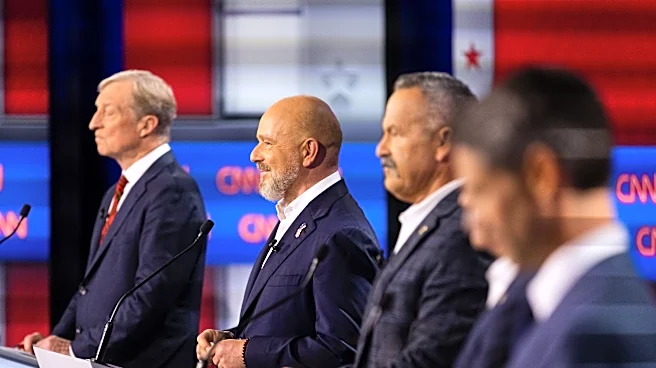
In the race to succeed Gavin Newsom as California's governor, single-payer healthcare has emerged as a pivotal issue. Leading Democratic candidates have embraced the concept as a political necessity to address voters' concerns over rising healthcare costs.
However, no candidate has provided a clear plan for funding such a system for California's 40 million residents. The debate has seen candidates spar over their commitment to a government-run model, with some, like Xavier Becerra, facing criticism for shifting positions. The concept of single-payer healthcare, once seen as a progressive dream, has become a mainstream topic in California, where Democrats significantly outnumber Republicans. Despite its popularity in discussions, the feasibility of implementing single-payer healthcare remains uncertain, with no clear funding strategy in place.
Why It's Important?
The focus on single-payer healthcare in California's gubernatorial race underscores a broader national conversation about healthcare reform. As healthcare costs continue to rise, the issue is a significant concern for voters, influencing their choices at the polls. The debate highlights the challenges of implementing large-scale healthcare reforms, particularly in terms of funding and political feasibility. The outcome of this race could set a precedent for other states considering similar healthcare models. Additionally, the discussion reflects the ideological divide between Democrats, who largely support government-run healthcare, and Republicans, who oppose it as a form of socialism. The race's outcome could impact healthcare policy not only in California but also influence national discussions on healthcare reform.
What's Next?
As the June 2 primary approaches, candidates will continue to debate their healthcare policies, with voters closely watching for concrete plans. The top two candidates, regardless of party affiliation, will advance to the November general election. The eventual winner will face the challenge of addressing healthcare costs and potentially pursuing single-payer healthcare. The federal government's stance will also play a crucial role, as implementing single-payer would require redirecting federal funds from programs like Medicaid and Medicare. The race's outcome could influence future healthcare policy discussions and set a benchmark for other states considering similar reforms.
Beyond the Headlines
The debate over single-payer healthcare in California also raises questions about the role of government in providing healthcare and the balance between public and private sectors. Ethical considerations include ensuring equitable access to healthcare and addressing disparities in healthcare outcomes. The discussion may also influence public perceptions of healthcare reform, shaping future policy debates. Long-term, the race could impact how healthcare is funded and delivered in the U.S., potentially leading to shifts in healthcare policy at both state and national levels.