





What's Happening?
Scientists have discovered that the absence of Earth's magnetic field significantly influences the lifespans of fruit flies, a finding that provides new insights into the aging process and potential risks associated with future human space travel. The
study, published in the journal Aging, involved observing two populations of fruit flies within a 'hypomagnetic' shield system, which effectively blocks the Earth's geomagnetic field. One group consisted of healthy 'wild-type' flies, while the other comprised 'mutant' flies with a Pink1 gene defect, linked to early-onset Parkinson's disease in humans and mitochondrial dysfunction. The removal of the magnetic field extended the lifespan of the Pink1 mutant flies by 20 percent but reduced their mobility. Conversely, the healthy flies experienced a reduced lifespan but improved mobility under the same conditions. This unexpected differential effect highlights the complex and previously underestimated interaction between Earth's magnetic field and biological aging mechanisms.
Why It's Important?
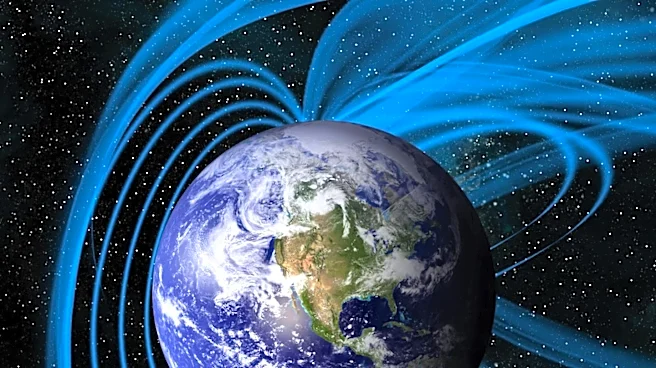
This research is crucial because all life on Earth has evolved under the planet's geomagnetic field, a protective shield that wards off harmful radiation. While the effects of stronger magnetic fields have been studied, the biological consequences of hypomagnetic fields have remained largely unknown. The findings suggest that the absence of this field can alter how cells age and produce energy, with measurable effects on longevity and behavior. For humans, this has significant implications for long-duration space missions beyond Earth's magnetic field, where astronauts are exposed not only to increased radiation but also to the absence of the geomagnetic field itself. Understanding these effects is vital for developing strategies to protect astronauts' health and ensure the success of deep space exploration. Furthermore, the study's insights into mitochondrial and behavioral changes could potentially inspire new therapeutic treatments for human conditions related to aging and mitochondrial dysfunction.
What's Next?
The researchers plan to expand their work by studying different organisms in hypomagnetic fields to determine if similar mitochondrial and behavioral changes are observed. This comparative approach will help to elucidate the universality of these effects across various species. The ultimate goal is to unravel the complex mechanisms underlying these observable changes, which could lead to a deeper understanding of how magnetic fields interact with living cells and their components, particularly mitochondria. These future investigations could inform the development of countermeasures or protective measures for astronauts undertaking missions beyond Earth's magnetic field. Additionally, the insights gained from this research may contribute to the development of novel therapeutic interventions for age-related diseases and conditions involving mitochondrial dysfunction, potentially leading to new treatments for humans.
Beyond the Headlines
This study opens up a fascinating new dimension in the field of chronobiology and environmental physiology, suggesting that an invisible force like Earth's magnetic field plays a more fundamental role in biological processes than previously understood. The differential response between healthy and mutant flies raises intriguing questions about the adaptive capacity of organisms to environmental changes and the potential for magnetic fields to influence disease progression. It also underscores the intricate balance of environmental factors that support life on Earth. From a broader perspective, this research could prompt a re-evaluation of how we consider environmental influences on health and aging, potentially leading to new areas of research in geomagnetism and its biological impacts. The 'startling' nature of these findings challenges existing assumptions and highlights the vast unknowns in our understanding of life's interaction with its planetary environment.