




What's Happening?
In 1915, San Diego faced a severe water shortage, with the Morena Reservoir nearing empty. Desperate city councilmen turned to Charles Hatfield, a self-proclaimed 'moisture accelerator' or 'pluviculturist,' who claimed he could induce rain using a secret
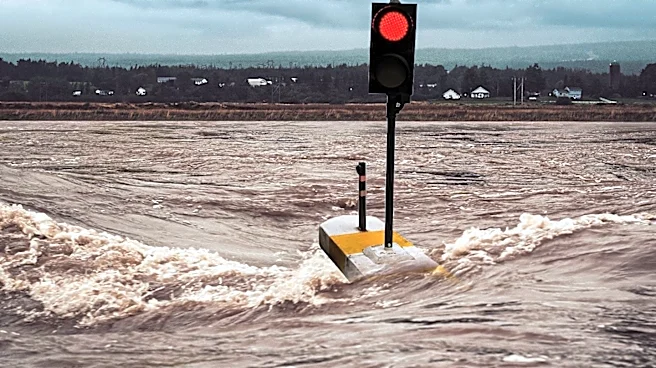
mixture of 23 chemicals released from towers. A verbal agreement was struck: Hatfield would receive $10,000 if he could fill the reservoir to overflowing. Hatfield and his brother constructed their tower near Lake Morena in December 1915, and by January 5, 1916, heavy rains began. What followed was a catastrophic flood, with storms continuously hitting Southern California for weeks. Bridges and railway lines were destroyed, and on January 27, 1916, the Lower Otay Dam collapsed, releasing a wall of water that resulted in an estimated 20 fatalities. The Morena Reservoir not only filled but overflowed dramatically, fulfilling Hatfield's promise under the strict terms of the agreement.
Why It's Important?
This historical event highlights the complex relationship between human intervention, natural phenomena, and legal accountability. San Diego's decision to hire Hatfield, despite skepticism from the U.S. Weather Bureau, underscores the desperation communities can face during environmental crises. The subsequent flood and the city's refusal to pay Hatfield unless he accepted responsibility for the damages led to a two-decade-long legal battle. This case set a precedent regarding liability for unforeseen consequences when engaging with unconventional solutions to environmental problems. The incident also illustrates the public's willingness to believe in extraordinary solutions when faced with dire circumstances, even when scientific explanations suggest otherwise. The event's legacy includes inspiring cultural works, such as the 1956 film 'The Rainmaker,' and continues to be cited in discussions about weather modification and geoengineering.
What's Next?
While the immediate legal battle concluded in 1938 with a ruling that the storms were an 'act of God,' absolving Hatfield of liability but also denying him payment, the story's implications continue to resonate. Modern meteorologists now understand the 1916 storms as a 'Pineapple Express,' an atmospheric river that would have occurred regardless of Hatfield's efforts. However, the event serves as a cautionary tale for future endeavors in weather modification and climate intervention. As technology advances, the potential for large-scale environmental manipulation grows, raising questions about ethical considerations, unforeseen consequences, and legal frameworks for accountability. The historical precedent of the San Diego flood suggests that clear contracts and a thorough understanding of scientific principles are crucial before implementing such ambitious projects, to avoid similar disputes and disasters.
Beyond the Headlines
The story of Charles Hatfield delves into the deeper human tendency to seek control over nature, particularly in times of crisis. Hatfield, who rebranded himself as a 'moisture accelerator' rather than a 'rainmaker' to appear more scientific, capitalized on public desperation and a lack of widespread meteorological understanding. His success, often coinciding with naturally occurring weather patterns, blurred the lines between genuine scientific endeavor, showmanship, and outright fraud. The legal battle that ensued after the flood exposed the challenges of assigning blame when natural events intersect with human actions, especially when those actions are based on unproven methods. This historical episode offers a lens through which to examine contemporary debates around climate change mitigation and geoengineering, prompting reflection on the ethical boundaries of human intervention in natural systems and the societal implications of such attempts.