








What's Happening?
EraDrive, a Palo Alto, California-based startup specializing in autonomous capabilities for satellites, has been awarded a $13 million contract by the Department of Defense (DoD). This award, granted under the Accelerate the Procurement and Fielding of Innovative
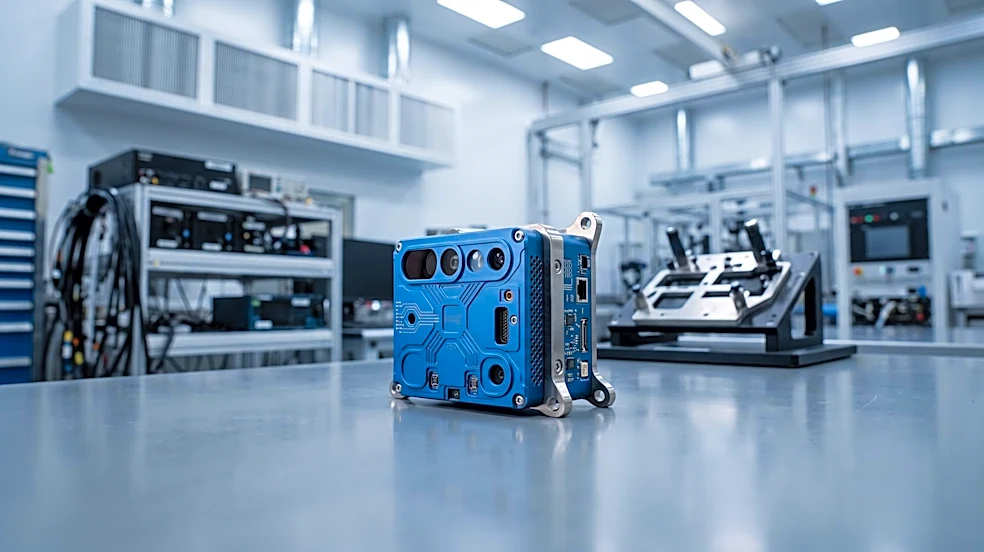
Technologies (APFIT) program, will enable the Space Force to acquire an unspecified number of EraDrive's Era-Node vision-based autonomy modules. The APFIT award is designed to provide direct procurement funding for new capabilities, accelerating the transition of innovative technologies from development to operational use, unlike traditional research and development-focused awards. This marks a significant step for EraDrive in bringing its satellite autonomy technology to military applications.
Why It's Important?
This DoD award is crucial for enhancing the resilience and operational independence of U.S. military satellites. Autonomous capabilities are increasingly vital for space assets, particularly in contested environments where traditional ground control links might be compromised or delayed. The Era-Node modules aim to provide satellites with the ability to operate autonomously, including navigation in GPS-denied environments, space domain awareness, and rendezvous and proximity operations (RPO). This reduces reliance on constant ground communication, making satellites more robust and responsive. For the U.S. Space Force, this technology addresses long-standing needs for more agile and self-sufficient space operations, which is critical for maintaining a strategic advantage in space. For EraDrive, this award provides significant validation and a direct pathway to integrate its technology into national security systems.
What's Next?
The $13 million DoD award will facilitate the accelerated procurement of EraDrive's Era-Node modules by the Space Force. While the modules have not yet flown in their fully integrated form, their components and software have demonstrated flight heritage through experiments on NASA's Starling satellites. The next steps will likely involve the integration of these Era-Node modules onto Space Force spacecraft, followed by in-orbit testing and validation of their autonomous capabilities. EraDrive also aims for each Era-Node to become part of a larger sensor network, providing fleet-level intelligence for collision avoidance and space domain awareness. This suggests a future where U.S. military satellites operate with a higher degree of autonomy and interconnectedness.
Beyond the Headlines
The push for satellite autonomy, exemplified by EraDrive's technology, represents a paradigm shift in space operations. Historically, satellites have been heavily reliant on ground control for tasking and navigation. True autonomy, as envisioned by EraDrive, allows satellites to make real-time decisions within defined parameters, significantly enhancing their survivability and effectiveness in dynamic space environments. This has profound implications for military strategy, enabling more resilient and distributed space architectures. Ethically, the increasing autonomy of military assets in space raises questions about human oversight and decision-making in critical situations. Legally, it may necessitate new frameworks for regulating autonomous operations in orbit. Culturally, it signifies a growing trust in artificial intelligence and machine learning for complex, high-stakes missions.