









What's Happening?
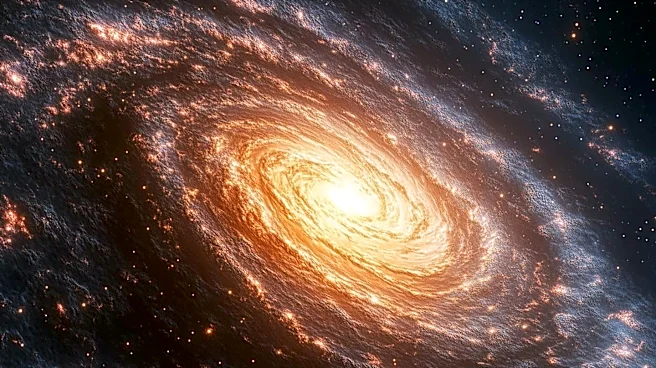
In early July, the center of the Milky Way galaxy becomes visible in the night sky, offering a spectacular view for stargazers. Located above the southern horizon, the center can be found near the Teapot asterism in the constellation Sagittarius. This
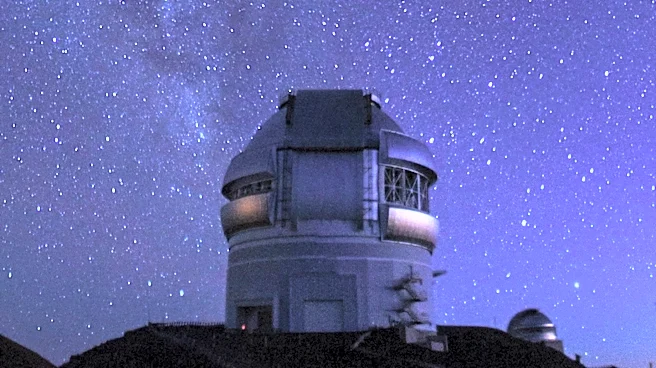
region of the sky is home to Sagittarius A*, the supermassive black hole at the heart of our galaxy. Observers with dark-adapted eyes and clear skies can see the Milky Way's plane as a diffuse band of light, with dark dust lanes cutting through it. This view is a result of the galaxy's disk-shaped spiral structure, which appears as a stripe across the sky.
Why It's Important?
The visibility of the Milky Way's center provides a unique opportunity for both amateur and professional astronomers to observe and study the structure of our galaxy. This event enhances public interest in astronomy and encourages educational activities related to the cosmos. Observing the Milky Way's center allows for a better understanding of the galaxy's composition and dynamics, including the role of supermassive black holes. Such events also promote awareness of the importance of dark skies and the impact of light pollution on astronomical observations.
What's Next?
As the summer progresses, the Milky Way will continue to be a prominent feature in the night sky, offering ongoing opportunities for observation and study. Stargazers are encouraged to take advantage of clear nights to explore the galaxy's structure and other celestial phenomena. Efforts to reduce light pollution and preserve dark skies will be crucial in maintaining the visibility of such astronomical events. Additionally, continued public engagement and education about the Milky Way and other cosmic features will foster a deeper appreciation for the universe.