



What's Happening?
A new study titled 'Categorizing Congestion: A Framework for Congestion Analysis across Urban Area Counties' has introduced an advanced system for measuring and predicting urban traffic congestion. Authored by Meredith Raymer, Hani Mahmassani, and Jennifer
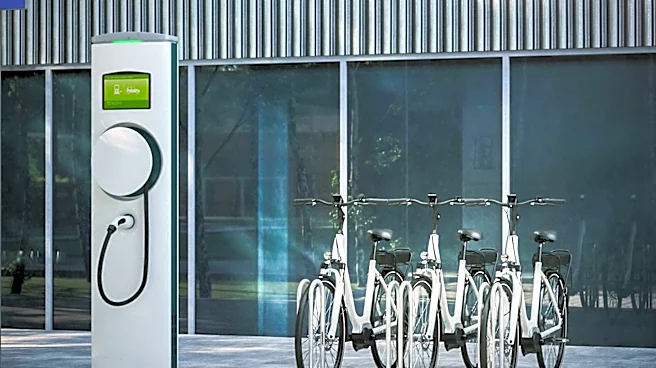
Duthie, the research addresses the limitations of existing congestion metrics by combining various data sources that record phenomena associated with congestion, such as low speed and high delay. This framework synthesizes long-term and short-term urban congestion dynamics, grouping counties into different congestion categories based on observed patterns. The study aims to provide a more accurate measurement and prediction tool, serving as an early-warning system for urban planners. It also highlights the potential of investing in active mobility infrastructure, like bike lanes, to mitigate congestion growth, particularly in areas with low bike lane density. The findings are intended to assist transportation engineers and planning professionals in developing more targeted and effective interventions to manage urban traffic.
Why It's Important?
Urban congestion significantly impacts mobility, quality of life, environmental health, and economic growth across the United States. The current lack of a nationally comparable metric that captures within-metro heterogeneity and a unified predictive model has hindered effective congestion management. This new framework, with its 'congestion propensity index (CPI),' offers a predictive measure that allows for a ranked comparison of expected congestion development in cities nationwide. By transforming widely available data into robust county-level measures, it accounts for heterogeneity within urbanized areas alongside national trends. The model integrates established relationships between variables such as population density, active modes of transportation, and the spatial distribution of opportunities. This comprehensive approach is crucial for policy decision-making, enabling the implementation of policies that are tailored to specific urban and suburban dynamics, ultimately leading to more efficient and sustainable urban development.
What's Next?
The proposed congestion propensity index (CPI) is designed to act as an early-warning system, allowing urban planners to identify areas with a higher likelihood of future congestion. This predictive capability will enable proactive rather than reactive measures. Transportation engineers and planning professionals are expected to utilize this updated approach to congestion analysis to implement more targeted and effective interventions. The study's emphasis on active mobility infrastructure suggests a potential shift in urban planning strategies, with increased investment in bike lanes and other non-vehicular transport options. Future steps will likely involve the integration of this framework into existing urban planning tools and continued research to refine the model and its application across diverse urban landscapes in the U.S. The goal is to foster a more data-driven approach to alleviate traffic issues and improve urban living.
Beyond the Headlines
Beyond the immediate benefits of improved traffic flow, this research has deeper implications for urban development and public health. By providing a more nuanced understanding of congestion, it encourages a shift towards multimodal planning and demand management incentives, moving away from solely expanding urban highways, which often offer only temporary relief. The study implicitly challenges the notion that congestion is merely an inconvenience, reframing it as a significant cost imposed by the disproportionate space required by private vehicles. This perspective could lead to a re-evaluation of urban infrastructure priorities, promoting sustainable transportation options and fostering healthier, more accessible cities. The ethical dimension lies in ensuring equitable access to efficient transportation for all residents, while the long-term shift could involve a fundamental change in how U.S. cities are designed and how residents commute, prioritizing community well-being and environmental sustainability over individual vehicle reliance.