
What's Happening?
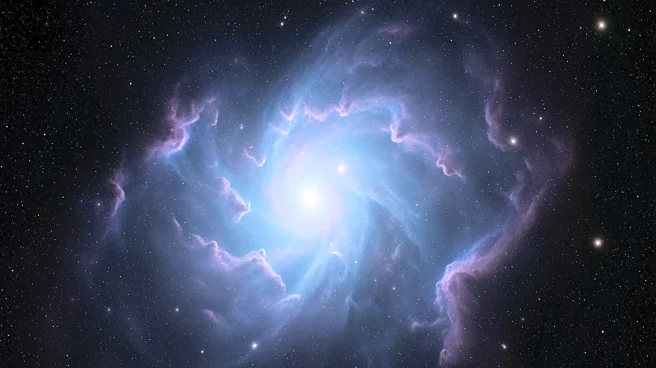
Astronomers using the Hubble Space Telescope have identified a new type of cosmic object, dubbed 'Cloud 9', which is a dark matter and gas cloud devoid of stars. Located 14 million light-years away near
the spiral galaxy Messier 94, Cloud 9 offers a unique opportunity to study dark matter, which constitutes a significant portion of the universe's mass but remains largely undetectable. The discovery of this Reionization-Limited Hydrogen I Cloud (RELHIC) provides insights into the early universe's galaxy formation processes.
Why It's Important?
The discovery of Cloud 9 is significant for astrophysics as it provides a rare glimpse into the dark universe. Understanding dark matter is crucial for comprehending the universe's structure and evolution. This finding could help scientists unravel the mysteries of galaxy formation and the role of dark matter in the cosmos. The research could lead to further discoveries of similar objects, enhancing our knowledge of the universe's composition and the forces shaping it.
What's Next?
Astronomers will continue to monitor Cloud 9 and conduct further surveys to identify more failed galaxy RELHICs. These efforts aim to deepen our understanding of dark matter and its influence on cosmic structures. The scientific community anticipates that future observations may reveal more about the conditions necessary for star formation and the potential for Cloud 9 to evolve into a fully-formed galaxy.