


What's Happening?
A recent study has uncovered the formation of abiotic polycyclic aromatic hydrocarbons (PAHs) in the Earth's upper mantle, challenging previous assumptions about organic synthesis in geological settings. The research, conducted through Raman microscopy
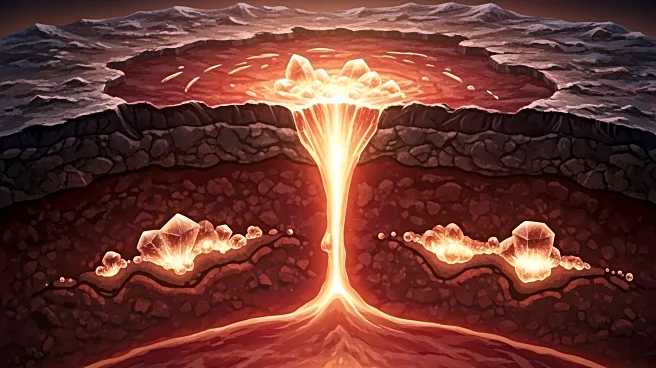
and STXM-XANES analyses, found that these hydrocarbons are not biological contaminants but are formed under high-temperature and high-pressure conditions. The study suggests that PAHs and other carbon species like CO and CO2 are formed independently of biotic activity, under reducing conditions in the mantle. This discovery was made in spinel-bearing abyssal peridotites, which are part of the oceanic mantle lithosphere, indicating that such formations occur at significant depths and under specific redox conditions.
Why It's Important?
The findings have significant implications for our understanding of organic matter formation in the Earth's mantle. Traditionally, abiotic organic synthesis was thought to be confined to subduction zones and mid-ocean ridges, where serpentinisation creates reducing conditions. However, this study demonstrates that such synthesis can occur independently of serpentinisation, expanding the potential for abiotic organic matter formation across the entire sub-oceanic upper mantle. This could alter our understanding of carbon cycles and the potential for natural gas or petroleum generation in these deep geological settings. The presence of PAHs in the mantle also suggests that the conditions for organic synthesis are more widespread than previously believed.
What's Next?
Further research is needed to explore the mechanisms and conditions under which these hydrocarbons form. Experimental and theoretical studies focusing on reaction kinetics and mineral catalysis could provide deeper insights into the universality of PAHs formation in the mantle. Understanding the temperature and pressure effects on organic compound characteristics in the mantle could also reveal more about the potential for aliphatic-rich hydrocarbons, which are precursors to natural gas and petroleum. These studies could significantly impact the energy sector by identifying new sources of hydrocarbons.
Beyond the Headlines
The study challenges the traditional view that serpentinisation is a prerequisite for abiotic organic synthesis, suggesting that the Earth's mantle may host a variety of organic compounds formed under diverse conditions. This could lead to a reevaluation of the mantle's role in the global carbon cycle and its potential as a source of hydrocarbons. The findings also raise questions about the geological processes that contribute to the formation of complex organic molecules, which could have implications for understanding the origins of life and the potential for life on other planets.