


What's Happening?
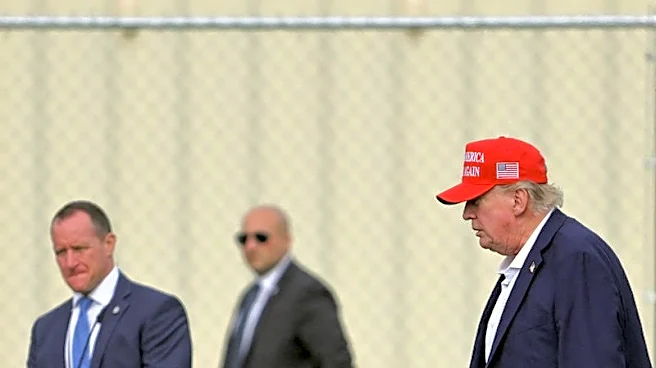
President Trump has confirmed the existence of a secret communication channel between U.S. officials and Iran's Islamic Revolutionary Guard Corps (IRGC) to facilitate negotiations. This confirmation follows reports that Trump administration officials bypassed
official Iranian negotiators to directly engage with IRGC leaders. The unusual outreach was reportedly initiated in May when then-Director of National Intelligence, Tulsi Gabbard, contacted Nechirvan Barzani, President of the Kurdistan region in Iraq, who has trusted relationships with both the U.S. and Iran. Gabbard asked Barzani to reach out to IRGC commander General Ahmad Vahidi to ascertain if Vahidi and other IRGC leaders agreed with the terms being negotiated by Iran's Parliament Speaker Mohammad Bagher Ghalibaf and Foreign Minister Abbas Araghchi, or if they had additional demands. Vahidi reportedly confirmed that the IRGC was in agreement with the Iranian negotiators. This direct communication highlights the U.S.'s difficulty in negotiating with Iran, given uncertainties about who truly controls power within the country, especially with the new Supreme Leader Ayatollah Mojtaba Khamenei. The Trump administration subsequently requested Barzani to host secret talks between U.S. and Iranian negotiators in Erbil, though these talks never materialized due to Iranian security concerns regarding Israeli intelligence presence in Iraq.
Why It's Important?
The establishment of a secret communication channel with the IRGC underscores the complex and often opaque nature of U.S.-Iran relations, particularly during sensitive negotiations. By bypassing official diplomatic channels and engaging directly with the IRGC, the Trump administration acknowledged the IRGC's significant influence over Iran's military and economic sectors, suggesting that any lasting agreement would require their implicit or explicit approval. This approach could be seen as an attempt to cut through bureaucratic red tape and address the real power brokers in Iran, potentially leading to more effective, albeit unconventional, diplomatic outcomes. However, it also carries risks, as it could undermine the authority of official Iranian negotiators and complicate future diplomatic efforts. The move also highlights the U.S.'s strategic reliance on regional intermediaries like Nechirvan Barzani, who possess unique access and trust with both sides. The failure of the proposed secret meeting in Erbil due to security concerns further illustrates the deep-seated mistrust and geopolitical complexities that continue to hinder direct U.S.-Iran dialogue, emphasizing the fragility of any potential breakthroughs.
What's Next?
The confirmation of this secret channel, despite the current stalemate in official negotiations, suggests that the U.S. may continue to explore unconventional diplomatic avenues to engage with Iran. While the immediate prospect of a comprehensive agreement remains uncertain, the willingness of both sides to engage in back-channel communications, even if indirectly, indicates a potential for future dialogue. The U.S. administration might continue to leverage intermediaries to gauge the IRGC's stance on various issues, especially as the political landscape in Iran evolves. However, the Iranian government's concerns about security and the presence of foreign intelligence in potential meeting locations will likely remain a significant hurdle for any future secret talks. The ongoing tensions in the Strait of Hormuz and the broader region will also continue to influence the dynamics of any potential negotiations, with both sides likely to maintain a cautious and strategic approach. Future developments will depend on the political will of both nations to overcome existing mistrust and find common ground, possibly through renewed efforts to establish secure and mutually acceptable communication channels.
Beyond the Headlines
The use of a secret communication channel with the IRGC raises profound questions about the future of international diplomacy and the role of non-state actors or powerful military organizations in shaping foreign policy. This approach challenges traditional diplomatic norms, where negotiations are typically conducted through official government representatives. It suggests a recognition by the U.S. that in certain geopolitical contexts, the real power may lie outside the formal governmental structure, necessitating direct engagement with influential entities like the IRGC. This could set a precedent for how the U.S. and other nations approach negotiations with countries where internal power dynamics are complex and fragmented. Furthermore, the reliance on a third-party intermediary like Nechirvan Barzani highlights the critical, yet often unacknowledged, role of regional leaders in facilitating high-stakes international diplomacy. The ethical implications of bypassing elected officials to negotiate with a military organization designated as a terrorist entity by the U.S. also warrant consideration, potentially blurring lines between diplomacy and engagement with adversaries. This strategy reflects a pragmatic, albeit controversial, attempt to navigate the intricate web of power in the Middle East.