





What's Happening?
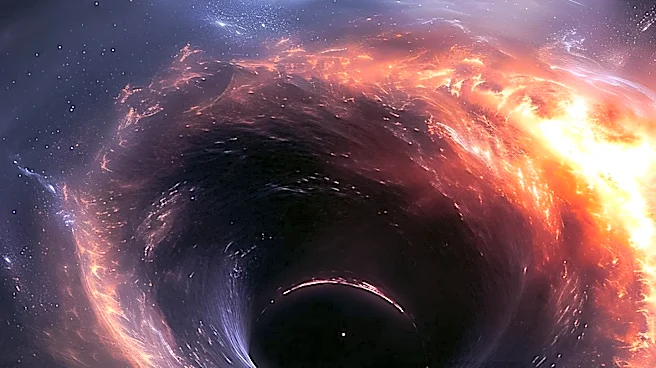
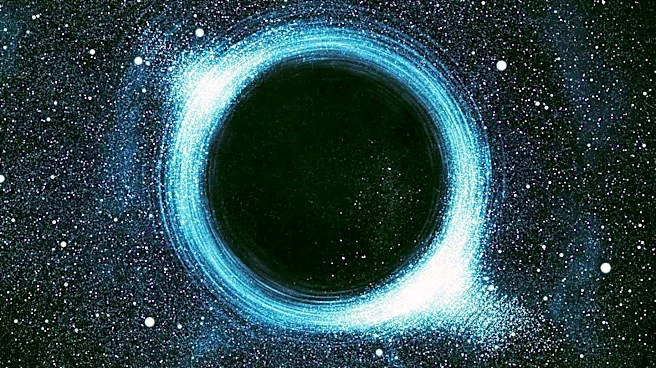
Recent studies have revealed that merging black holes form distinct subpopulations, challenging the notion of a single uniform group. Using data from gravitational wave detectors like LIGO, Virgo, and KAGRA, researchers have identified different formation
mechanisms for these black holes. The studies, published in Physical Review Letters, highlight a population of unusually massive black holes, each about 40 times the mass of the sun. These findings suggest that some black holes are 'second-generation' events, formed from previous mergers rather than stellar collapse.
Why It's Important?
Understanding the formation of black holes is crucial for astrophysics, as it sheds light on the evolution of galaxies and the universe. The discovery of distinct subpopulations helps explain how black holes can exist in mass ranges previously thought impossible. This knowledge could also provide insights into the growth of supermassive black holes at the centers of galaxies. As gravitational wave detectors become more sensitive, they will offer clearer distinctions between these subpopulations, enhancing our understanding of cosmic phenomena.