


What's Happening?
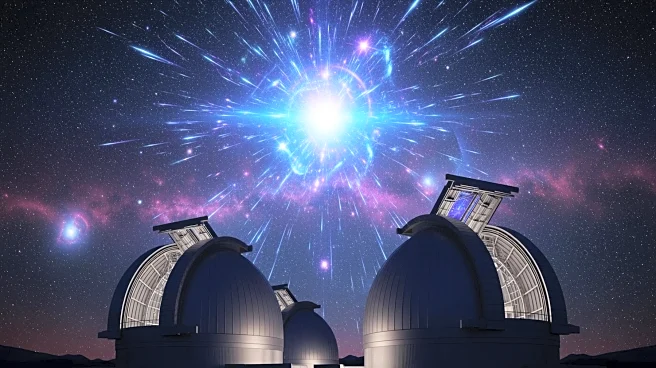
Astronomers using the Gemini North and Blanco telescopes have observed GRB 250702B, the longest gamma-ray burst ever recorded, lasting over seven hours. This event, first detected by NASA's Fermi Gamma-ray Space Telescope, has prompted a global effort
to study its origins. The burst is believed to have originated from a galaxy outside the Milky Way, surrounded by significant amounts of dust. Researchers are exploring several potential causes, including interactions between a star and a black hole or a neutron star. The findings are published in The Astrophysical Journal Letters.
Why It's Important?
The discovery of GRB 250702B provides valuable insights into the nature of gamma-ray bursts, which are among the most powerful explosions in the universe. Understanding these events can help scientists learn more about the life cycles of stars and the dynamics of galaxies. The study of such extreme cosmic phenomena also contributes to our knowledge of the universe's evolution and the fundamental processes that govern it. The ability to observe and analyze these bursts with advanced telescopes highlights the importance of continued investment in astronomical research and technology.
What's Next?
Further observations and analyses are needed to conclusively determine the cause of GRB 250702B. Astronomers will continue to use ground-based and space-based telescopes to gather more data and refine theoretical models. The ongoing study of gamma-ray bursts will likely lead to new discoveries about the universe's most extreme events and may reveal previously unknown aspects of cosmic evolution.