







What's Happening?
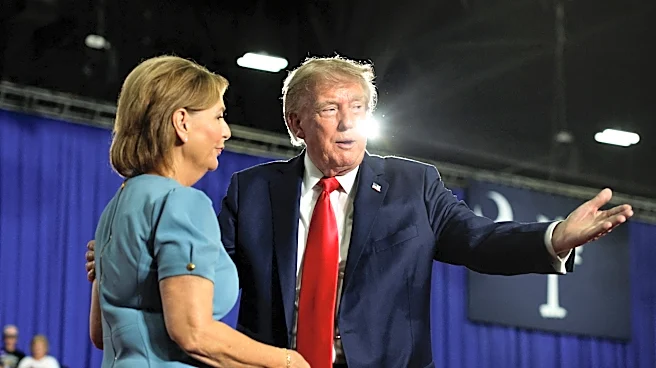
Darline Graham, a political newcomer backed by President Trump, has won the Republican nomination for a full term as Senator from South Carolina. Graham secured 52.4 percent of the vote, defeating Representative Ralph Norman in a run-off election. Her
victory comes despite a notable moment during a recent debate where she struggled to answer questions regarding Taiwan and the South China Sea as U.S. national security issues. Graham, who was appointed to the Senate seat in July following the death of her brother, acknowledged during the debate that she was not well-informed on national security matters, stating, 'I am not that informed on national security, but I do support the military.' This response drew significant media and social media attention, leading to questions about her qualifications for the Senate. In contrast, her opponent, Ralph Norman, provided a more detailed answer, identifying Taiwan as a 'definite ally' and highlighting its semiconductor industry.
Why It's Important?
Graham's victory, despite her acknowledged lack of expertise on critical foreign policy issues like Taiwan and the South China Sea, highlights the significant influence of presidential endorsements in Republican primaries, particularly from President Trump. South Carolina is a Republican stronghold, making the primary nomination largely determinative of the general election outcome. This event underscores a potential shift in the qualifications voters prioritize, where alignment with a popular political figure might outweigh detailed policy knowledge for some constituents. The incident also brings into focus the increasing importance of Taiwan and the South China Sea in U.S. foreign policy discussions, particularly given Taiwan's critical role in the global semiconductor industry. A senator's understanding of these complex geopolitical issues is crucial for effective policymaking and national security, and Graham's perceived unpreparedness could raise concerns about her future contributions to these debates.
What's Next?
Having secured the Republican nomination, Darline Graham is widely expected to win the general election in November, given South Carolina's strong Republican leanings. Her campaign will likely focus on consolidating support within the Republican base and addressing any lingering concerns about her policy expertise. It remains to be seen how she will prepare for and engage with national security and foreign policy discussions if elected to a full term. Her future performance in the Senate will be closely watched, particularly regarding her stance and contributions on issues related to China, Taiwan, and broader U.S. foreign policy. The outcome of this election could also serve as a case study for future political campaigns, illustrating the power of endorsements versus policy depth in certain political climates. Her political trajectory will be influenced by her ability to grow into the role and demonstrate a deeper understanding of complex international relations.
Beyond the Headlines
This election outcome reflects a broader trend in U.S. politics where candidate authenticity and alignment with a political movement can sometimes overshadow traditional qualifications or detailed policy knowledge. The public's reaction to Graham's debate performance, ranging from criticism to continued support, reveals differing expectations for political leaders. It also highlights the challenge for political newcomers to quickly grasp and articulate positions on complex international issues that have significant implications for U.S. economic and national security interests. The contrast with her late brother, a prominent foreign-policy hawk, further emphasizes the evolving nature of political dynasties and the individual paths of their successors. This situation could spark further debate about the role of expertise in governance and the criteria voters use to select their representatives, especially in an era of heightened geopolitical tensions.