
What's Happening?
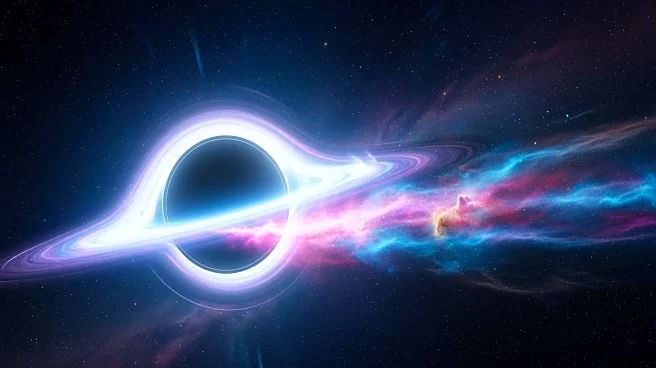
Astronomers have observed a supermassive black hole (SMBH) named AT2018hyz, which has been emitting increasing levels of energy since it was first detected in 2018. Initially spotted by the All Sky Automated Survey for SuperNovae, the black hole's energy output
has risen sharply, now 50 times brighter than when first observed. Researchers, led by Yvette Cendes from the University of Oregon, have identified two potential scenarios for this increase: a delayed spherical outflow or an astrophysical jet. The ongoing study, published in The Astrophysical Journal, suggests that the energy emissions will continue to rise until 2027, making it one of the most energetic events ever recorded.
Why It's Important?
The findings about AT2018hyz challenge existing understandings of tidal disruption events (TDEs) and black hole behavior. The unprecedented energy output, comparable to a gamma-ray burst, suggests that other black holes might exhibit similar characteristics, which have not been previously observed due to the competitive nature of securing telescope observation time. This discovery could lead to a reevaluation of how astronomers study black holes and TDEs, potentially uncovering new insights into the universe's most powerful phenomena. The research also highlights the need for continued observation to verify these findings and explore their implications further.
What's Next?
Researchers plan to continue monitoring AT2018hyz across multiple frequencies to better understand the evolution of its energy emissions. This ongoing study aims to distinguish between the proposed scenarios of delayed outflow and astrophysical jet. The findings could influence future proposals for telescope time, as the scientific community may prioritize similar studies to explore other potential high-energy black holes. The results could also impact theoretical models of black hole behavior, prompting further research into the mechanisms driving such extreme energy outputs.