






What's Happening?
A new species of carnivorous dinosaur, Invictibellatrix amberina, has been identified from a fossil that remained unexamined in the London Natural History Museum for nearly a century. The skull fragment, originally discovered in 1924 on the Isle of Wight
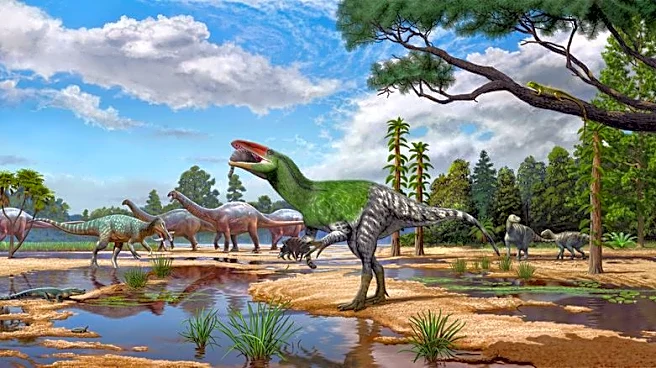
by amateur fossil hunter Reginald Walter Hooley, was recently re-examined using high-resolution CT scanning technology. This advanced imaging allowed researchers to create a 3D model of the cranial cavity, revealing unique anatomical features such as an oval spinal entrance and an hourglass crest along the skull roof. These distinct characteristics confirmed that the fossil belonged to a previously unknown species. Invictibellatrix amberina, meaning 'unconquered female warrior,' lived approximately 120 million years ago during the Early Cretaceous period. It was an agile carnivore, estimated to be between 3 and 4 meters long and about 1.5 meters tall, functioning similarly to a modern hyena by preying on smaller reptiles and early mammals. This discovery marks the first confirmed evidence of a megaraptoran dinosaur in Europe, a group previously thought to be confined to Asia, South America, and Australia.
Why It's Important?
The identification of Invictibellatrix amberina is significant for several reasons, particularly in rewriting the understanding of theropod migration and evolution. The presence of a megaraptoran in Europe challenges previous theories that these dinosaurs originated in Asia and then spread directly to the southern supercontinent Gondwana (comprising present-day Africa, South America, and Antarctica) without a European presence. This new species suggests that megaraptorans traversed northern continents during the Early Cretaceous, filling a crucial gap in the fossil record and indicating a more complex migratory path than previously assumed. For paleontologists, this discovery underscores the immense value of historical museum collections, demonstrating that significant scientific breakthroughs can still emerge from re-examining long-held specimens with modern technology. The find also contributes to the broader understanding of dinosaur diversity and ecosystem dynamics during the Early Cretaceous, providing insights into the types of predators that inhabited Europe and their ecological roles. The study highlights how advanced imaging techniques can unlock secrets from fossils that have been overlooked for decades, potentially leading to further discoveries from existing collections.
What's Next?
Following this discovery, researchers will likely continue to explore historical museum collections for other overlooked specimens that could yield new insights with modern analytical tools. The identification of Invictibellatrix amberina opens avenues for further investigation into the migratory patterns of megaraptorans and other theropods, potentially leading to a revised understanding of prehistoric landmass connections and faunal exchanges. Future research may focus on finding more complete fossils of Invictibellatrix amberina or related species in Europe to better understand their anatomy, behavior, and evolutionary relationships. Paleontologists might also investigate the environmental factors or competitive pressures that led to the eventual disappearance of megaraptorans from Europe. The ongoing application of CT scanning and other non-invasive technologies to existing fossil collections is expected to continue revealing new species and refining our knowledge of ancient life, encouraging a re-evaluation of previously cataloged but unanalyzed specimens worldwide.
Beyond the Headlines
This discovery extends beyond mere classification, offering profound implications for the field of paleontology and the public's engagement with science. Ethically, it highlights the responsibility of museums and scientific institutions to continually re-evaluate and utilize their collections, ensuring that valuable specimens are not left unexamined. The story of a fossil sitting in a drawer for a century before revealing a new species serves as a powerful narrative about patience in scientific inquiry and the unexpected places where knowledge can be found. Culturally, the enduring fascination with dinosaurs, particularly in the U.S. where a significant portion of the population expresses interest in these creatures, means that such discoveries can inspire new generations of scientists and foster public support for paleontological research and museum funding. The ability of technology to unlock ancient secrets from seemingly ordinary objects also reinforces the interdisciplinary nature of modern science, where geology, biology, and advanced imaging converge to expand our understanding of Earth's history.