



What's Happening?
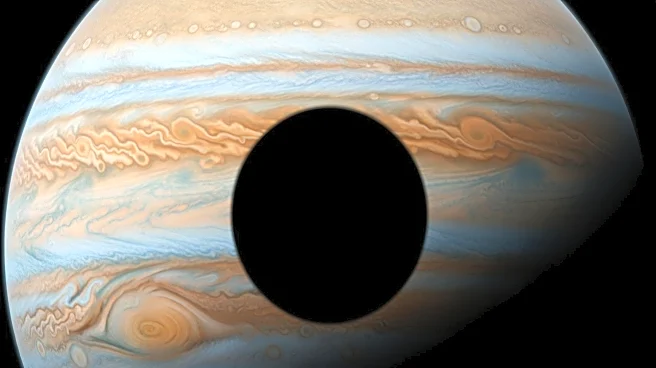
An astronomical event involving Jupiter's moon Io and its shadow was observed overnight from December 27th into December 28th. The event began with Io's shadow appearing on Jupiter's cloud tops at 12:28 A.M. EST, followed by Io itself at 12:48 A.M. EST.
Both reached a central position on Jupiter's disk by 1:45 A.M. EST. The shadow departed Jupiter's western limb around 2:45 A.M. EST, with Io following at 3:05 A.M. EST. During this period, the configuration of Jupiter's Galilean moons changed, with Io joining Callisto on the western side of the planet post-transit.
Why It's Important?
This event is significant for astronomers and space enthusiasts as it provides a clear view of the dynamics of Jupiter's moons and their interactions with the planet. Such transits offer valuable opportunities for studying the gravitational interactions and orbital mechanics of celestial bodies. Observing these events can enhance our understanding of the solar system's largest planet and its moons, contributing to broader astronomical knowledge.
What's Next?
Future observations of similar transits can provide more data on the orbital characteristics of Jupiter's moons. These events are also opportunities for amateur astronomers to engage with celestial phenomena, potentially inspiring interest in astronomy and space science. Continued monitoring of Jupiter and its moons will aid in refining models of their movements and interactions.