



What's Happening?
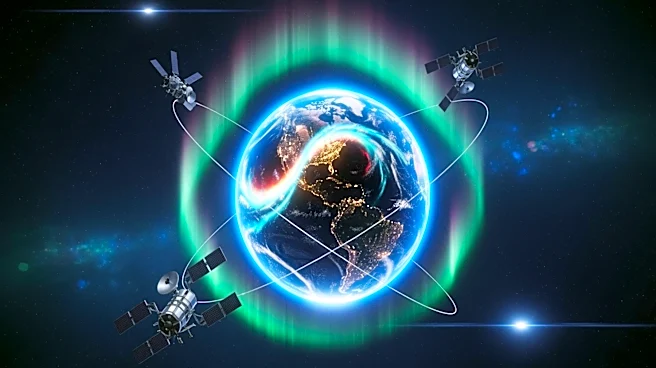
The European Space Agency's Swarm-AWARE project is utilizing Swarm satellites to improve the characterization and prediction of space weather and natural hazards. These satellites collect data on Earth's magnetic field, plasma densities, and electric
fields, which are integrated with ground-based observations to distinguish between signals caused by space weather and those from natural hazards. The project aims to enhance infrastructure resilience and early-warning systems by providing more accurate predictions of space weather impacts. The research, presented at the European Geosciences Union General Assembly, highlights the potential of Swarm satellites to advance our understanding of the near-Earth environment.
Why It's Important?
The ability to accurately predict and differentiate between space weather effects and natural hazards is crucial for protecting critical infrastructure and communication systems. Space weather events, such as solar storms, can disrupt power grids, satellites, and other technologies, posing significant risks to modern society. By improving the accuracy of space weather predictions, the Swarm-AWARE project can help mitigate these risks and enhance the resilience of infrastructure. This research supports the development of more reliable early-warning systems, which are essential for minimizing the impact of space weather on human activities and technological systems.
What's Next?
The Swarm-AWARE project will continue to leverage advanced data analysis techniques, such as machine learning, to improve the accuracy of space weather predictions. The integration of satellite and ground-based data will provide a more comprehensive understanding of the interactions between space weather and the Earth's environment. As the project progresses, it is expected to contribute to the development of more effective mitigation strategies and decision-making tools for managing space weather risks. The insights gained from this research will also inform future scientific studies and support the advancement of space weather forecasting capabilities.