

What's Happening?
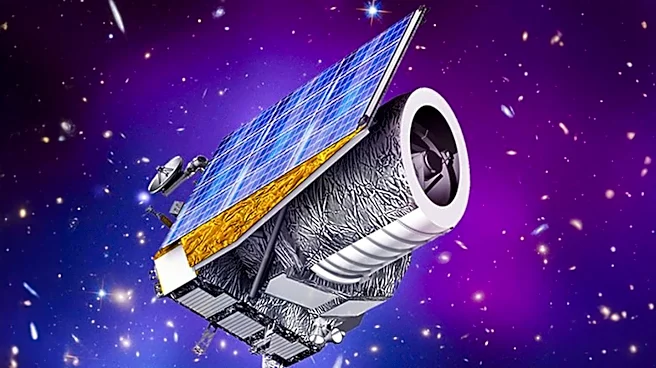
NASA's Nancy Grace Roman Space Telescope has successfully completed a critical milestone by precisely aligning its instruments, moving it closer to commencing science operations. According to Dominic Benford, Roman’s program scientist at NASA Headquarters,
this telescope requires exceptional alignment, needing to be at least ten times more stable than the Hubble or Webb space telescopes due to its broad view and the need for minimal measurement uncertainties. The Roman team adjusted the positions of the secondary mirror, a smaller mirror connecting to the Coronagraph Instrument, and all masks and optics within the instrument to optimize its vision. This alignment process involved correcting for shifts caused by launch vibrations, temperature changes, and the absence of gravity in space, which can subtly alter the observatory's internal structure. Scientists conducted test observations, comparing star positions in Roman's images with expected locations to fine-tune future aiming and correct minor drifts. The Wide Field Instrument serves a dual role, acting as the primary instrument and a guider, tracking stars to maintain the telescope's stability during observations.
Why It's Important?
The precise alignment of the Nancy Grace Roman Space Telescope's instruments is crucial for its mission to explore dark energy, dark matter, and exoplanets, which are fundamental mysteries in astrophysics. This level of precision, described as 'a tiny fraction of a hair’s breadth of perfection' by Tony Sohn, an astronomer at the Space Telescope Science Institute, is essential for accurately pointing the telescope and maintaining extreme stability during long observations. The Coronagraph Instrument, designed to block starlight to detect faint signals from orbiting planets, relies heavily on this exact alignment. Its ability to leverage the wave nature of light to redirect starlight and reveal exoplanets close to their stars represents a significant leap in astronomical observation capabilities. The Wide Field Instrument's dual function as both an imager and a guider ensures that even while the coronagraph is focused on exoplanet detection, the observatory remains steady, potentially yielding 'bonus deep fields' for scientists to analyze, opening new avenues for discovery in previously unexplored cosmic regions.
What's Next?
Following this successful alignment, the Roman team will proceed to exercise over 3,000 small, moving parts within the instrument's deformable mirrors. These mirrors are critical for the Coronagraph Instrument's ability to actively control and reject starlight, a process that has been demonstrated in laboratory settings but will be a record-breaking first in space with real starlight and planets. The next phase involves the active starlight control in space, which is expected to be a groundbreaking accomplishment. The telescope's ability to maintain stability while the Coronagraph Instrument stares at stars for extended periods will also provide valuable additional data from neighboring patches of sky, offering scientists new deep surveys. These subsequent steps are vital for the Roman Space Telescope to achieve its full scientific potential, enabling unprecedented observations of exoplanets and contributing significantly to our understanding of the universe's composition and evolution.
Beyond the Headlines
The technological advancements embodied in the Nancy Grace Roman Space Telescope, particularly its coronagraph and deformable mirrors, represent a significant evolution in space-based astronomy. The ability to precisely block starlight to directly image exoplanets, especially those close to their host stars, pushes the boundaries of what is observable. This development has profound implications for the search for life beyond Earth, as it could enable the characterization of exoplanet atmospheres and the detection of biosignatures. Furthermore, the telescope's broad field of view and high stability will contribute to a more comprehensive understanding of the universe's large-scale structure, dark energy, and dark matter, potentially leading to paradigm shifts in cosmology. The meticulous engineering and calibration required for such precision highlight the complexity and ingenuity involved in modern space missions, setting new standards for future astronomical observatories and fostering international collaboration in scientific exploration.