
What's Happening?
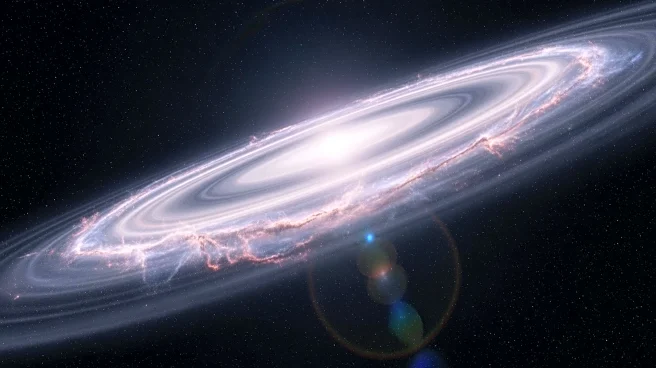
The Hubble Space Telescope has captured images of the largest protoplanetary disk ever observed, surrounding a young star system known as IRAS 23077+6707, or 'Dracula's Chivito.' This disk, located approximately
1,000 light-years from Earth, spans nearly 400 billion miles and is characterized by its chaotic and turbulent nature. The disk's structure is unusually asymmetric, with wisps of material extending far above and below the disk, visible only on one side. This discovery, published in The Astrophysical Journal, provides a unique perspective on planet formation in extreme environments. The disk's mass is estimated to be 10 to 30 times that of Jupiter, suggesting the potential for forming multiple gas giants.
Why It's Important?
This discovery marks a significant milestone in understanding planet formation, particularly in extreme environments. The chaotic nature of the disk challenges existing models of protoplanetary disks, suggesting that planet nurseries can be more active and complex than previously thought. The findings could lead to a reevaluation of how planets form and evolve, providing new insights into the diversity of planetary systems across the galaxy. The ability to observe such detailed structures in visible light allows scientists to study the processes shaping these disks, potentially leading to breakthroughs in our understanding of the early stages of planetary development.