




What's Happening?
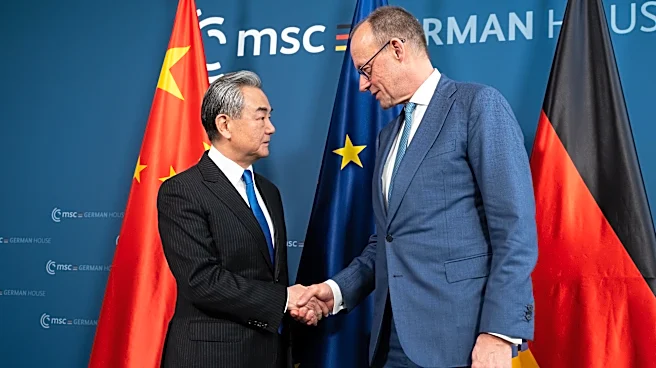
Chinese Ambassador to the United States, Xie Feng, has called for concerted efforts to implement the consensus reached by Chinese and U.S. leaders to foster a stable and sustained constructive relationship. Speaking at the Gala Dinner 2026 Celebrating
60 Years of the National Committee on US-China Relations, Ambassador Xie emphasized that both nations benefit from cooperation and face losses from confrontation. He highlighted the historic significance of the current year for China-U.S. relations, noting the exchange of state visits between President Xi Jinping and President Trump within half a year. These visits established an agreement to build a constructive China-U.S. relationship based on strategic stability, respect, fairness, and reciprocity, signaling potential for mutual complementarity. Ambassador Xie stressed the importance of adhering to red lines with respect, engaging in fair competition, and promoting mutual benefit to advance the relationship's steady development.
Why It's Important?
The call from Ambassador Xie Feng underscores the critical need for stability in China-U.S. relations, which has profound implications for global economics and geopolitics. The U.S. and China are the world's two largest economies, and their relationship significantly influences international trade, supply chains, and technological advancements. A stable relationship could lead to increased cooperation on global issues such as climate change, pandemics, and economic stability, benefiting both nations and the international community. Conversely, continued friction or confrontation could disrupt global markets, escalate trade tensions, and hinder efforts to address pressing global challenges. The emphasis on respect, fairness, and reciprocity suggests a desire to move beyond past disputes and establish a more predictable framework for engagement, which is crucial for U.S. businesses operating in China and for American consumers who rely on goods produced there.
What's Next?
Ambassador Xie urged both sides to fully utilize existing political and diplomatic channels, as well as economic and trade consultation mechanisms. He also called for enhanced exchanges and cooperation in various sectors, including military-to-military relations, law enforcement, science and technology, and people-to-people interactions. This suggests a potential for increased dialogue and collaboration across multiple domains. While acknowledging that the development of bilateral relations may not be without challenges, Xie expressed optimism that the historical trend favors progress. The focus will likely be on translating the leaders' consensus into concrete actions, which could involve further high-level meetings, working group discussions, and specific agreements aimed at managing differences and fostering cooperation. The U.S. response to these overtures will be critical in determining the immediate trajectory of the relationship.
Beyond the Headlines
Beyond the immediate diplomatic rhetoric, Ambassador Xie's remarks highlight a deeper recognition of the interdependence between China and the United States. The assertion that no global challenge can be resolved without their cooperation points to the systemic nature of their relationship. This perspective suggests that despite ideological differences and geopolitical competition, both nations are compelled by shared global responsibilities to find common ground. The call for a "constructive China-U.S. relationship of strategic stability" implies a long-term vision that seeks to institutionalize mechanisms for managing competition and preventing escalation. This could lead to a re-evaluation of existing policies and a push for more nuanced engagement strategies from both sides, potentially influencing how other nations navigate their relationships with these two global powers.