






What's Happening?
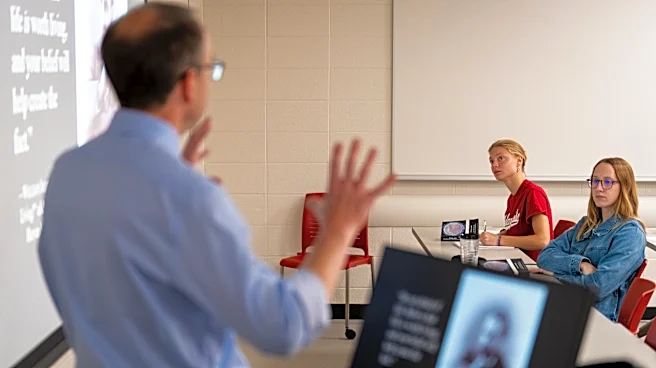
Virginia educators are grappling with the integration of artificial intelligence (AI) into classrooms, balancing its potential for innovation with concerns about student creativity and academic integrity. Professors Amy Allen and David Hicks from Virginia Tech’s
School of Education have been conducting workshops to guide teachers on responsible AI use, emphasizing its role in supporting critical thinking rather than serving as a shortcut. Alexandria City School Teacher Bernadette Desario noted that students, driven by academic pressure, often turn to AI for assistance, which can hinder the development of their own thought processes and creativity. The workshops focus on AI's capabilities, biases, and limitations, aiming to equip educators to utilize the technology thoughtfully. Virginia Tech is also exploring AI applications in other fields, such as studying hemorrhagic fever viruses, predicting pandemics, and enhancing transportation efficiency. The funding for these educational workshops was provided by the Center for Humanities and the Library of Congress’ Teaching with Primary Sources Partner Program.
Why It's Important?
The thoughtful integration of AI in education is crucial for preparing students for a future increasingly shaped by advanced technology, while simultaneously safeguarding fundamental learning processes. The current trend of students using AI as a shortcut highlights a critical challenge: how to leverage AI's benefits without undermining the development of essential skills like critical thinking and creativity. If not managed properly, over-reliance on AI could lead to a generation of students less capable of independent thought and problem-solving. For educators, understanding AI's nuances, including its biases and limitations, is vital to guide students effectively and ensure equitable access to its advantages. The efforts by Virginia Tech professors to train teachers reflect a proactive approach to this evolving landscape, aiming to establish best practices for AI use in academic settings. This initiative could serve as a model for other educational institutions nationwide as they navigate the complexities of AI integration.
What's Next?
Professors Amy Allen and David Hicks are scheduled to continue their AI workshops in Blacksburg and Abingdon through mid-November, further disseminating knowledge and best practices among Virginia's educators. These ongoing sessions will likely expand the number of teachers equipped to integrate AI responsibly into their curricula. The insights gained from these workshops and Virginia Tech's broader AI research could inform future educational policies and guidelines regarding AI use in schools. There may be continued discussions and debates among educators, policymakers, and parents about the appropriate boundaries and ethical considerations for AI in learning environments. The focus will remain on developing strategies that encourage students to use AI as a tool for enhancement rather than a replacement for their own intellectual efforts, potentially leading to the development of more sophisticated AI literacy programs.
Beyond the Headlines
The discussion around AI in education extends beyond mere technological adoption; it touches upon deeper philosophical questions about the nature of learning, intelligence, and human creativity in an AI-driven world. The concern that AI might diminish students' original thought processes raises ethical dilemmas about the purpose of education itself. Is education primarily about knowledge acquisition, or is it about fostering unique human capabilities that AI cannot replicate? The example of an Anne Frank-themed chatbot providing inappropriate answers underscores the ethical pitfalls of AI, particularly in sensitive subjects like history, where nuanced understanding and empathy are paramount. This highlights the need for critical evaluation of AI-generated content and the importance of human oversight. The long-term implications could involve a redefinition of academic rigor and assessment methods, pushing educators to design assignments that require higher-order thinking and creative problem-solving that AI cannot easily replicate, thereby preserving the human element in intellectual development.