








What's Happening?
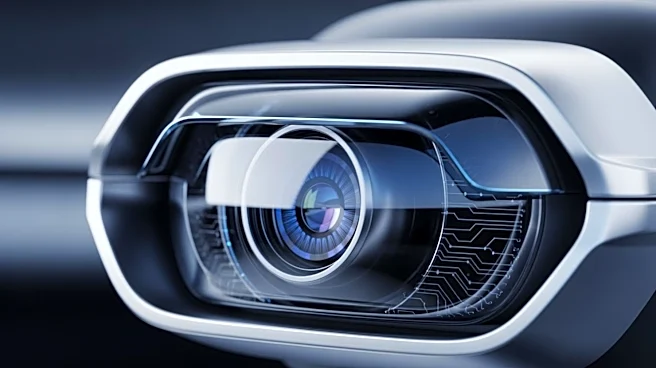
Researchers at Penn State have engineered a new sensor called a photomemristor, designed to improve the vision of autonomous vehicles by mimicking the human eye. This sensor, inspired by the natural function of rods and cones in human eyes, is capable
of dynamically adapting to changing light conditions. The photomemristor is constructed from a gel-like plastic and titanium oxide, allowing it to adjust quickly between bright and dark environments. In tests, the sensor demonstrated a 95% accuracy rate in identifying objects under mixed lighting conditions, outperforming traditional systems. This development aims to address the challenges faced by driverless cars in adverse weather and lighting conditions, potentially making them more reliable on the road.
Why It's Important?
The advancement of photomemristor technology could significantly impact the autonomous vehicle industry by enhancing the reliability of self-driving cars in various lighting conditions. This improvement is crucial as companies like Waymo and Zoox expand their driverless car operations. The ability to quickly adapt to sudden changes in light can prevent accidents and improve safety, addressing a major concern in the deployment of autonomous vehicles. Additionally, this technology could extend beyond automotive applications, potentially aiding visually impaired individuals and enhancing the capabilities of humanoid robots in industrial settings.
What's Next?
The research team plans to expand the sensor's capabilities into a multimodal system that can process both visual and tactile data. This development could further enhance the functionality of autonomous vehicles and other robotic systems. As the technology matures, it may be integrated into commercial driverless cars, improving their performance in real-world conditions. The potential applications in assisting visually impaired individuals and enhancing robotic vision systems also present opportunities for future research and development.