









What's Happening?
North Korea has significantly reinforced its border with South Korea, laying approximately 960,000 mines along the Demilitarized Zone (DMZ) since 2024. This extensive fortification effort also includes clearing vegetation to create barren buffer strips,
constructing walls, barbed-wire fences, and tactical roads, while simultaneously severing rail and road links between the two Koreas. These actions are understood as part of a broader campaign to physically express a legal and ideological project aimed at making the separation of the two Koreas permanent. This campaign follows Pyongyang's abandonment of the goal of unification in 2023 and its redefinition of inter-Korean relations as those between 'two hostile states.' The 2026 constitutional amendment further codified this shift, placing sovereignty at the center of national priorities.
Why It's Important?
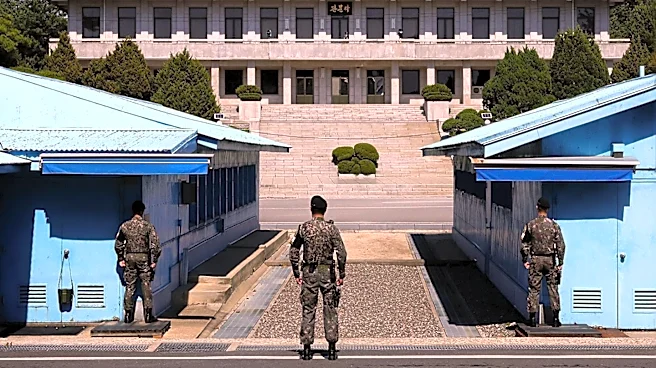
The massive fortification of the DMZ and the accompanying doctrinal shift by North Korea have profound implications for regional stability and the future of inter-Korean relations. By laying nearly a million mines and constructing extensive barriers, North Korea is creating a physical manifestation of its declared status as a separate and hostile state from South Korea. This militarization, while not necessarily indicative of an imminent attack, significantly increases the risk of unintended clashes due to the erosion of armistice mechanisms and the lack of clear demarcation of the Military Demarcation Line (MDL). The absence of mutually agreed datasets for the MDL's precise location, coupled with North Korean soldiers reportedly crossing the line frequently, creates a volatile environment where live-fire exercises or tit-for-tat responses could easily escalate. For the United States, a key ally of South Korea, these developments necessitate heightened vigilance and strategic planning to prevent conflict and maintain stability in a critical geopolitical region.
What's Next?
In the near term, the DMZ is expected to become progressively more militarized as North Korea continues to implement its strategy of emphasizing sovereignty and separateness. While an all-out attack appears unlikely, the risk of unintended clashes will remain high due to the erosion of communication channels and the ambiguity surrounding the MDL. South Korea may respond by reinforcing its security through non-escalatory measures such as expanding guard posts, deploying additional patrols, and utilizing robotic systems for mine-clearing operations. The restoration of military hotlines is becoming increasingly urgent, but achieving this may require Seoul to signal an acceptance of North Korea's borders, which could conflict with South Korea's constitutional claim over the entire peninsula. A sustainable reduction of tensions may ultimately depend on South Korea undertaking its own legal changes to redefine its understanding of its territory, a complex political challenge.
Beyond the Headlines
The extensive militarization of the DMZ by North Korea represents more than just a security measure; it is a tangible expression of a fundamental shift in its national identity and foreign policy. By abandoning the goal of unification and constitutionally defining itself as a separate, hostile state, Pyongyang is attempting to solidify its international standing and internal narrative. This move challenges the long-held aspirations for a unified Korea and forces both Koreas, and the international community, to confront a new reality. The ethical implications of laying nearly a million mines, which pose a long-term threat to both human life and the environment, are significant. Furthermore, the breakdown of communication and the ambiguity of the MDL highlight the fragility of peace agreements when underlying political wills diverge. This situation underscores the need for innovative diplomatic approaches that acknowledge the evolving political landscape while prioritizing de-escalation and conflict prevention.